Blog / Systems
Systems · Buyer guide
Can You Knead Bread or Pizza Dough on a Stainless-Steel Worktop?
The short answer
You can consider kneading dough directly on a stainless-steel worktop when the supplier confirms that the finished surface is suitable for that food-contact use and you follow its cleaning instructions. Test your usual recipe and tools before choosing the setup. Steel does not guarantee nonstick handling, a cold surface or easy pizza transfer.
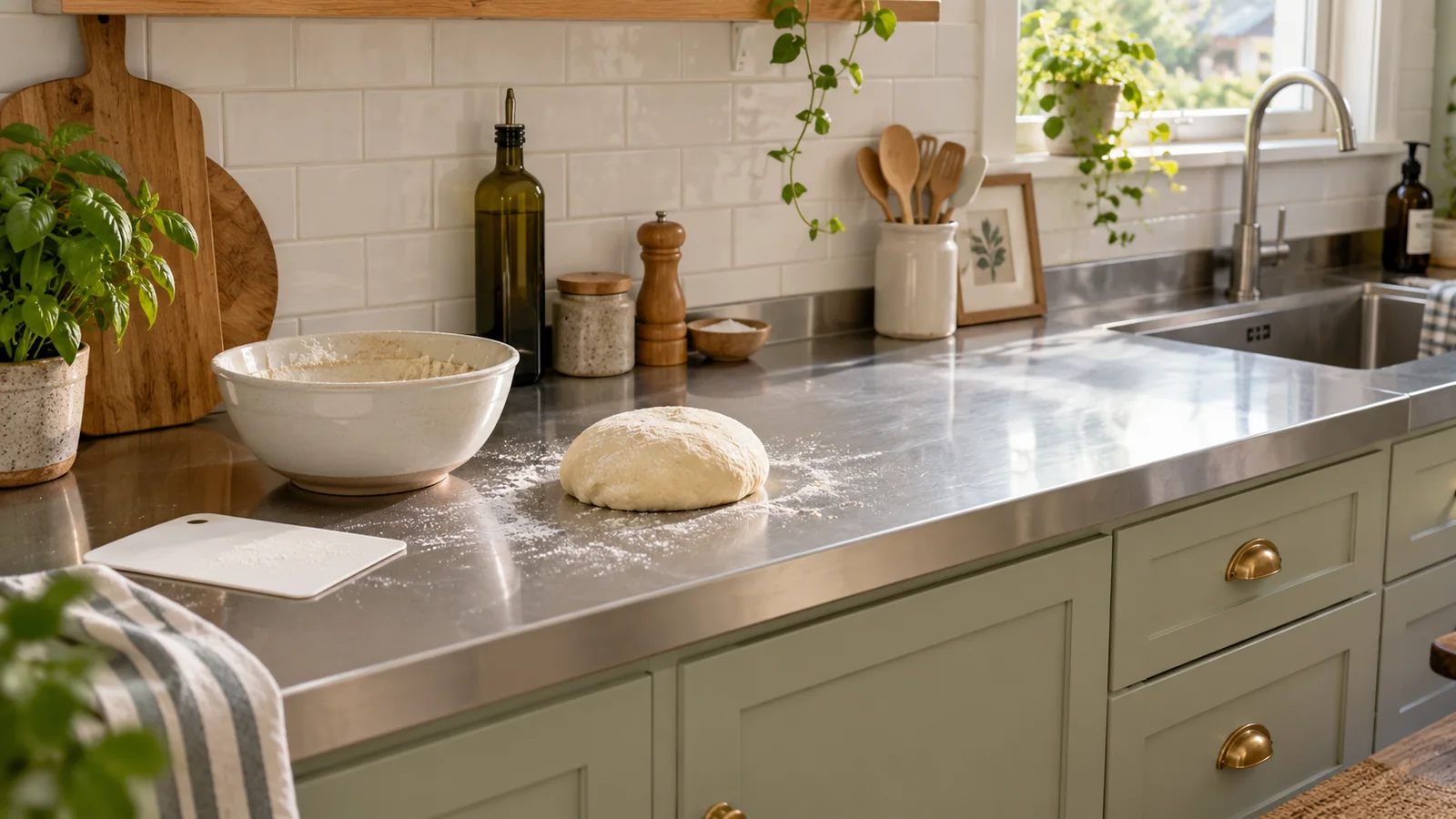
When you make pizza at home, the bowl, flour container and peel need somewhere to go while you shape the dough. A steel worktop above wood, white or coloured cabinet fronts can provide that preparation zone. Start with your own baking routine rather than a photograph of a professional bakery table.
This guide helps you assess the preparation area. It is not a bread recipe, a food-contact certification or a comparison test proving steel better than stone or wood.
Confirm the finished surface before direct food contact
Ask the supplier whether the exact finished surface is suitable for direct dough preparation. Request the care instructions, permitted tools and any restrictions relating to the finish. “Stainless steel” is not a complete description of an assembled worktop.
Make sure handover is complete before using the area. Protective film, unidentified adhesive and construction residue should be addressed through the supplier’s instructions, not covered with flour. Ask for clarification if the surface condition is uncertain.
If direct contact is not confirmed, consider a suitable food-preparation board or mat whose instructions match your intended use. Check its fit and storage as part of the kitchen plan. Choosing one does not make the worktop purchase a mistake; it may suit your existing routine.
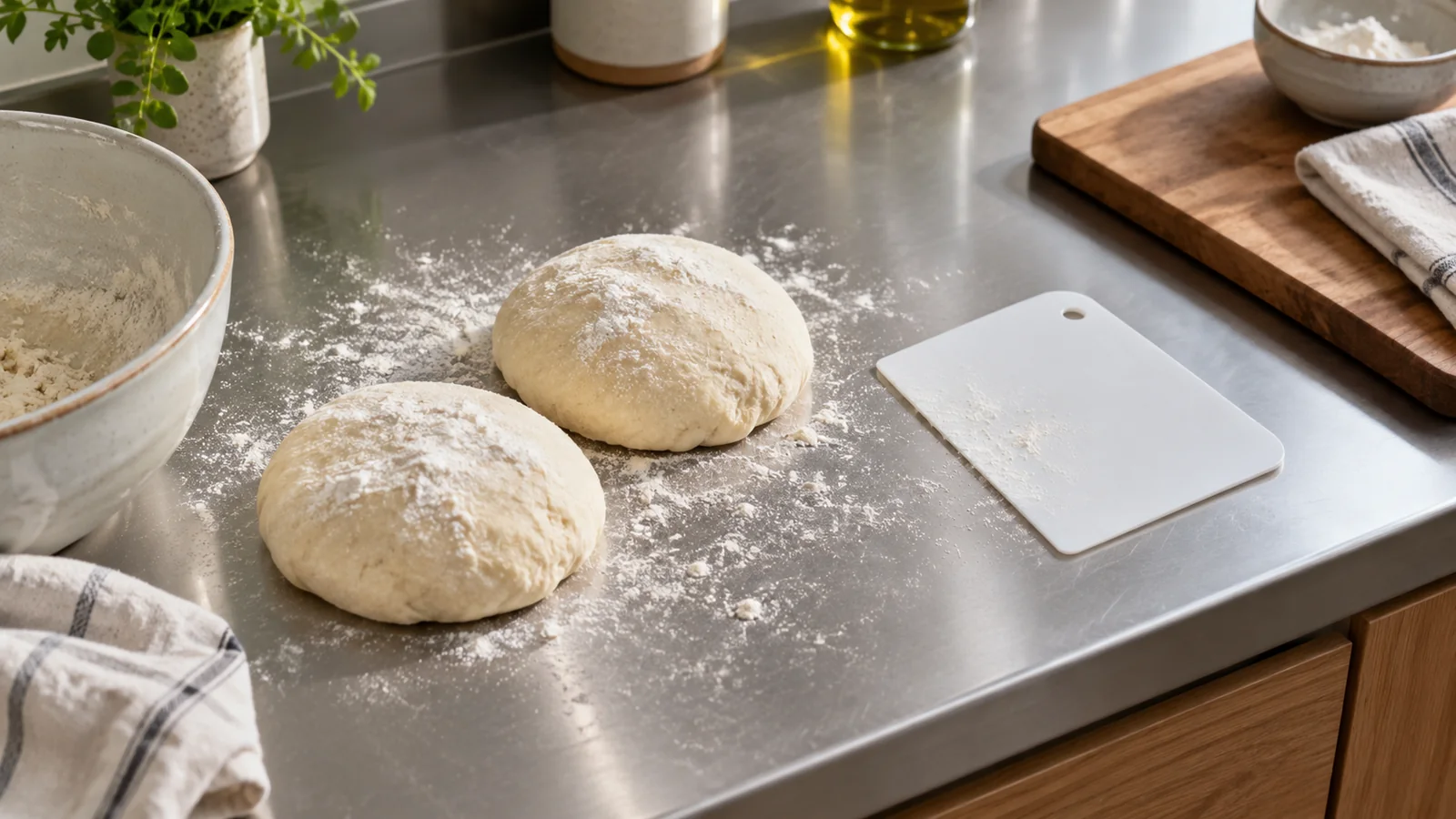
If the dough sticks, check the recipe before blaming the worktop
Start by separating the steps. Does the dough stick during kneading, after resting on the counter, when being lifted, or once it is on the pizza peel? Record the failure point before changing the surface.
Flour use varies by recipe and technique. King Arthur’s wet-dough hand-kneading example starts on an unfloured work surface and uses a scraper. Its New York-style pizza recipe uses flour for shaping and checks that the dough moves on the peel before loading. Neither establishes a rule for every dough on every worktop. See the wet-dough example and the pizza recipe.
Follow the chosen recipe rather than adding more flour indefinitely to make the counter feel nonstick. If you need technique advice, describe the recipe and the stage at which sticking occurs to a baking instructor or recipe author.
Keep the worktop care instructions in view too. A metal bench scraper demonstrated in a baking lesson is not evidence that it is approved for your particular decorative finish. Ask about permitted tools before selecting one.
Do a useful sample comparison
If possible, request a sample with the same finished surface being proposed for the kitchen. Ask whether it is suitable for a food-preparation trial and follow the supplied preparation and cleaning instructions.
A small sample can help assess touch and cleanup. It cannot reproduce the full kneading area, installed support or your movement around the kitchen. Use it for a limited comparison and note that boundary.
For a more informative trial, keep the recipe and handling method consistent:
- Record the recipe, dough stage and tools used.
- Observe where sticking occurs and how you release the dough.
- Clean according to the surface instructions and inspect it when dry.
- Compare the result with your usual board or mat, noting any changes in method.
Note what changed between trials. If the dough, proofing, tools and room conditions also changed, you cannot attribute the result to the worktop alone. A household trial can inform your choice without proving a material advantage.
Will steel always stay cool?
Do not buy on an “always cold” promise. Ask what conditions the proposed surface is intended for, and assess the preparation area where you will actually use it. A shaded indoor kitchen and a sun-exposed balcony are different setups.
For temperature-sensitive recipes, use the recipe’s guidance rather than assuming the counter provides temperature control. If that is an important part of your baking, include it in the sample discussion and record the conditions of the trial.
A stainless-steel kitchen worktop is also not a baking steel designed for use in an oven. Do not treat the worktop as an oven accessory or a guaranteed landing area for hot trays. Discuss a suitable landing arrangement and read our hot-pan guide.
Plan usable space, not just overall counter length
Mark a baking session on your kitchen drawing. Where do the mixing bowl, scales, flour container and dough sit? Where will a tray wait while you shape another piece? Where do the tools go during cleanup?
Subtract the sink, cooktop, standing appliances and the space normally occupied by washing up. The remaining uninterrupted area is more useful for this decision than the total length of the steel worktop.
Lay out your bowl, tray and peel on the proposed plan using their actual dimensions. An island section may suit one kitchen; a clear run beside the sink may suit another. Include the storage space for a board if you use one.
Include worktop height and storage in the review. Our worktop-height guide helps frame that discussion, while the drainboard and rack guide addresses competing uses around the sink.
Clean up raw dough as a food-safety task
CDC warns that raw flour and raw eggs can contain germs, advises against tasting raw dough and calls for washing hands, utensils and countertops after preparation. Stainless steel does not remove the need for those precautions. See CDC’s raw-dough guidance.
Choose a surface-care method that also meets the food-safety task. Ask the supplier if the required cleaning approach is unclear for the selected finish. Do not leave cleaner residue in a dough-preparation zone or invent a disinfectant mixture.
Keep raw-dough preparation separate from ready-to-eat serving until cleanup is complete. Include your chosen board or mat and tools in that routine according to their own instructions.
Questions home bakers ask
Do I need a special commercial steel table?
That is not the assumption here. Discuss a suitable preparation zone within your residential kitchen, with the finished surface and support arrangement confirmed for the intended use.
Will a brushed finish prevent sticking?
Do not assume that. Select the finish with its appearance and care requirements in mind, then assess your dough-handling routine. This guide contains no finish-specific nonstick test.
Can I keep using my usual kneading board?
Yes, if the board is suitable for the task and used according to its instructions. Plan where it rests and where it will be cleaned, dried and stored.
Design around your baking routine
Review the project before production
Share your residential kitchen plan for project review with your main baking tasks, tool dimensions, destination and local installation arrangements. Mark the clear preparation area you want to preserve.