Blog / Systems
Systems · Buyer guide
Will Workstation Accessories Fit Your Integrated Stainless Steel Sink?
The short answer
Workstation accessories fit only when their support geometry and clearances match the sink. A welded-in stainless steel bowl does not automatically provide accessory ledges, and a shared nominal size does not establish compatibility. Confirm the sink drawing and exact accessory models, then check how you will use, remove, clean and store them.
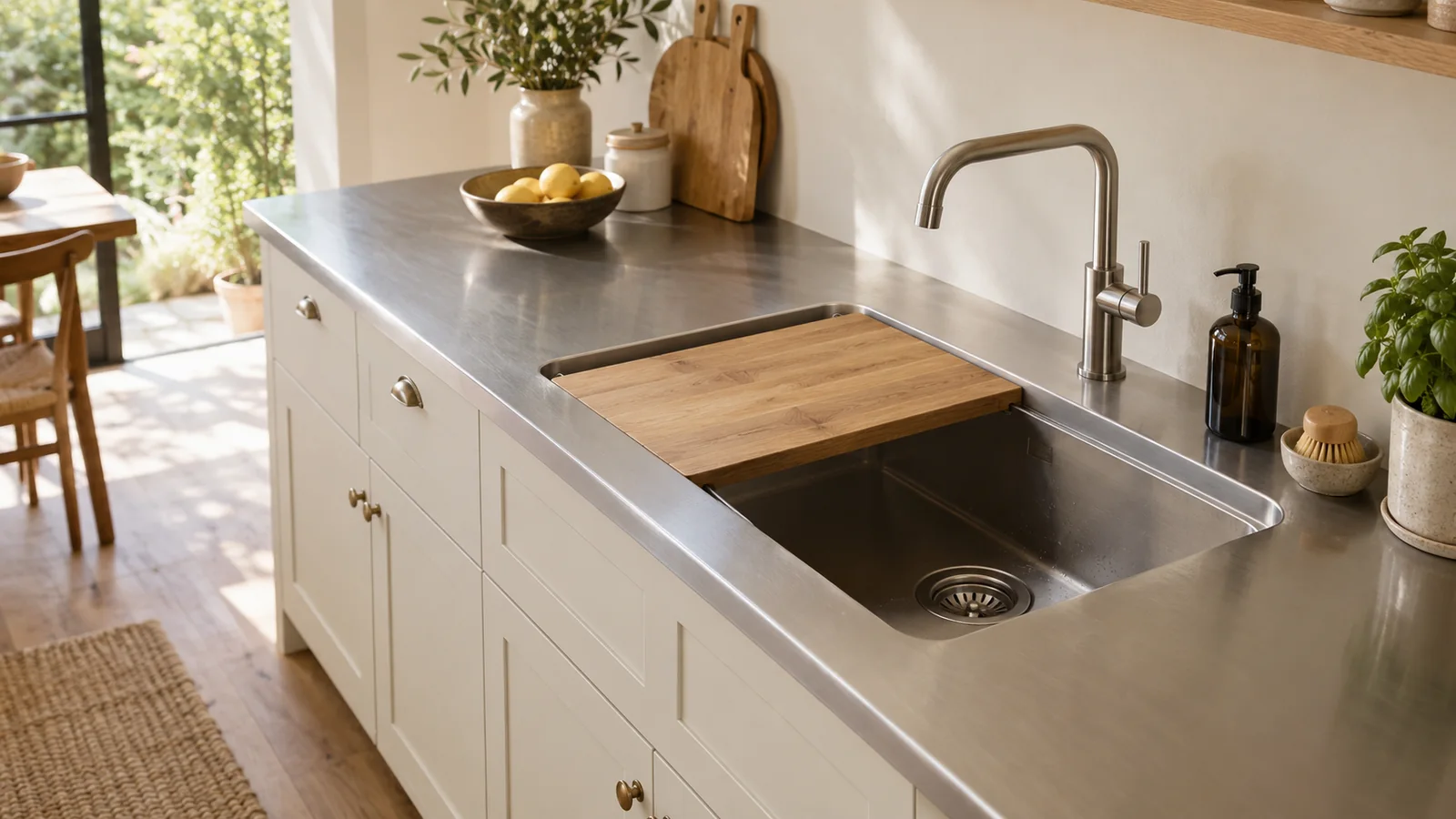
A board above the bowl looks useful in a photograph. At dinner time, you may need to remove it to wash a large pan while someone else is waiting for the tap. Work through that routine before asking a fabricator to incorporate the arrangement into a custom worktop.
In a Houzz discussion about workstation sinks, the original question concerned ledge cleaning and accessory storage. Replies differed: some users disliked the obstruction, while others valued their workstation after years of use. Those accounts identify useful questions to test; they do not show that one choice suits most kitchens.
Integration and a workstation ledge are separate features
“Integrated” may describe the connection between the sink and the steel worktop. “Workstation” describes an arrangement that supports accessories for tasks over the bowl. Ask the supplier to draw both features rather than accepting the two words as a complete specification.
A custom bowl could have a smooth wall without the support detail needed by your chosen board. An accessory designed to rest on the surrounding worktop may use a different contact surface from one designed for a recessed ledge. Establish where the accessory is intended to bear and how it is prevented from slipping during its intended use.
If you are still choosing the bowl, start with its ordinary washing-up role. The sink size and depth guide covers that decision. Accessories should be assessed with the pans and trays you need to wash, not only with the items shown in a product image.
A product family is not a universal fitting standard
Ruvati’s LedgeFit collection illustrates a manufacturer-defined ecosystem of workstation accessories. Its compatibility descriptions concern its own product family. They do not establish that a similarly sized accessory fits a different brand or a custom Anray sink.
Use model numbers and drawings instead of a label such as “fits a 30-inch sink.” Ask which dimension that label describes. It could refer to an overall product size rather than the support span the accessory needs. Your supplier should confirm the actual fit and intended loading for the specified pairing.
- Identify the surfaces supporting each end of the accessory.
- Confirm the clear span, contact width and relevant corner shapes on the drawing.
- Check the space needed to slide, lift out or rotate the item.
- Show nearby tap components, handles and any worktop overhang at the opening.
- Record the exact approved accessory model and any manufacturer’s load or use restrictions.
These are coordination fields, not universal dimensions. The fabricator and accessory supplier need to confirm what is adequate. A ruler measurement alone does not establish that an improvised pairing will be stable.
Rehearse one ordinary meal
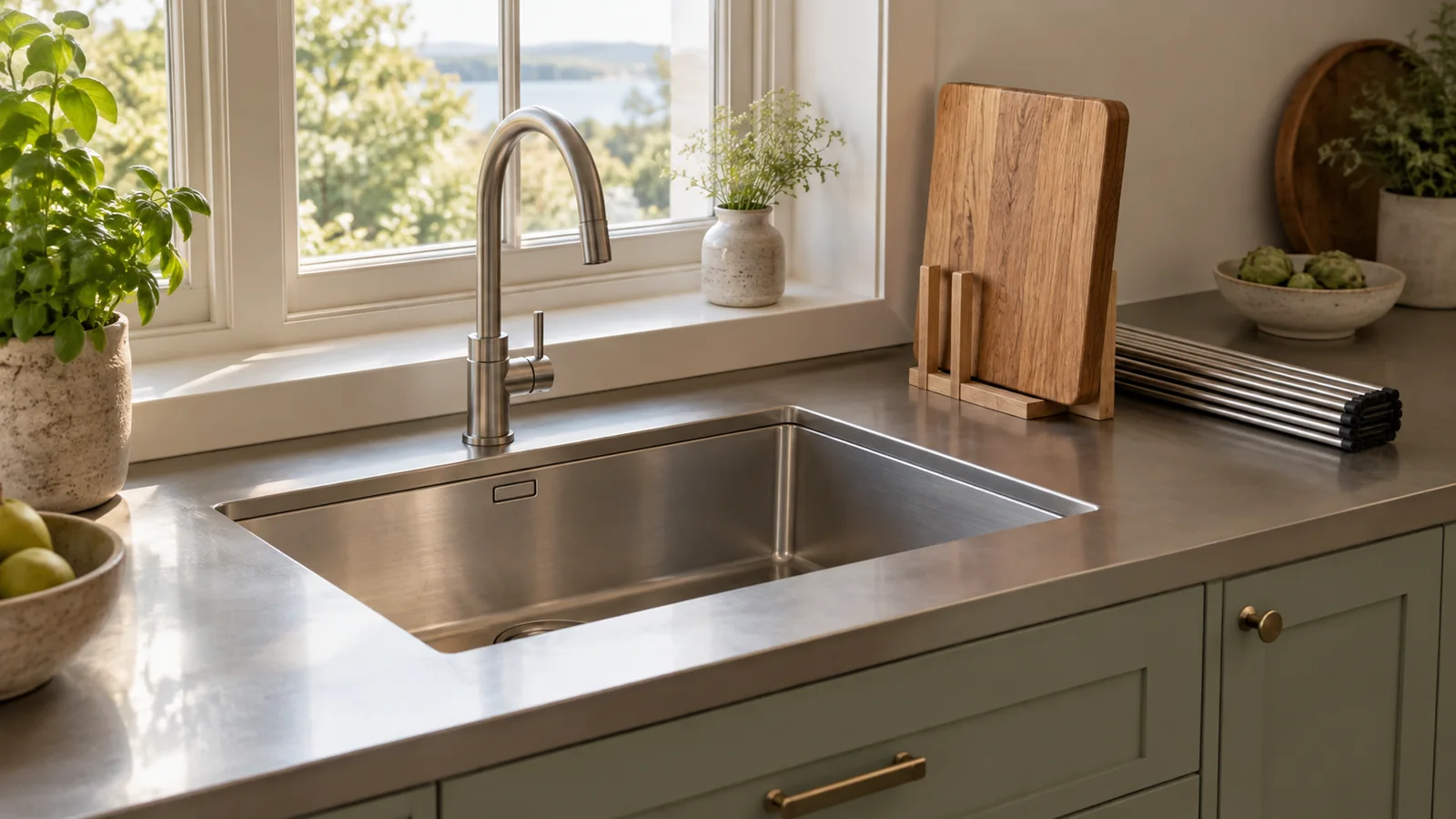
Choose a meal you actually prepare. Sketch the sink opening at scale or use a safely positioned paper layout to represent it. Mark the area occupied by each accessory and move the outlines through preparation, washing and drying. This is a space-planning exercise, not a structural or food-preparation test.
For example, while a board occupies part of the opening, where does the rinsed colander go? Can the other person reach the tap? When you need the whole bowl for a roasting tray, where will you put the wet board? If there is no answer without clearing another work surface, include that task in your decision.
Repeat the exercise with fewer accessories. You may find that one board is enough, or that you will use the whole arrangement. Write down which pieces you expect to use and where the others will go. That list is a better basis for the order than an attractive photograph of a complete kit.
Plan cleaning and storage with the sink
Ask to see how each accessory is removed and how the exposed ledge can be reached. Check the manufacturer’s care instructions for the board, rack or insert; do not assume every piece can go into a dishwasher or be cleaned with the same product as the steel bowl.
Identify a place where washed accessories can dry as instructed and be stored without obstructing the kitchen. Include that space in the cabinet layout. If a board is too large for its intended cupboard, finding that out from a drawing is preferable to discovering it after delivery.
Keep bottom accessories and top accessories separate in the plan. A bottom grid serves a different position from a sliding board. Similarly, the choice between an integrated drainboard and a removable rack deserves its own space review. Buying one does not settle the others.
Can you add a workstation arrangement later?
Ask the original sink supplier before adding rails, drilling, welding or attaching a homemade support. A completed bowl should not be treated as a blank fabrication exercise. Request an assessment of the proposed change, cleaning access, finish and warranty implications, and agree who would perform the work.
If an off-the-shelf accessory rests on the worktop rather than a ledge, check that exact product’s compatibility and stability requirements. Do not improvise supports because its advertised overall width happens to be close. A supplier-confirmed removable solution may avoid changing the bowl, but compatibility still needs to be established.
Keep a replacement path in the order record
List the sink revision, approved accessories and supplier references together. Ask whether a replacement board or rack can be ordered separately at your destination. Current availability does not guarantee permanent supply, so discuss what information would be needed to evaluate a future replacement.
Where fit is critical, agree a trial-fit check using the specified items before shipment if the supplier can provide it. Record what was checked and what remains for the local installer. Do not assume a general cabinet trial assembly includes every sink accessory.
Review the project before production
Considering a workstation-style sink in a residential steel kitchen? Send Anray Works the sink layout and accessory model list, along with the tasks you want to perform. Feasibility and compatibility need project-specific confirmation; the customer arranges final site measurement and local installation.