Blog / Systems
Systems · Buyer guide
Are Bottom Grids Worth It in an Integrated Stainless-Steel Sink?
The short answer
A bottom grid can be useful if you want a raised resting surface for cookware and are willing to remove and clean it regularly. It is optional. For a custom integrated stainless-steel sink, judge the grid against the actual bowl shape, drain position and daily washing routine before ordering it.
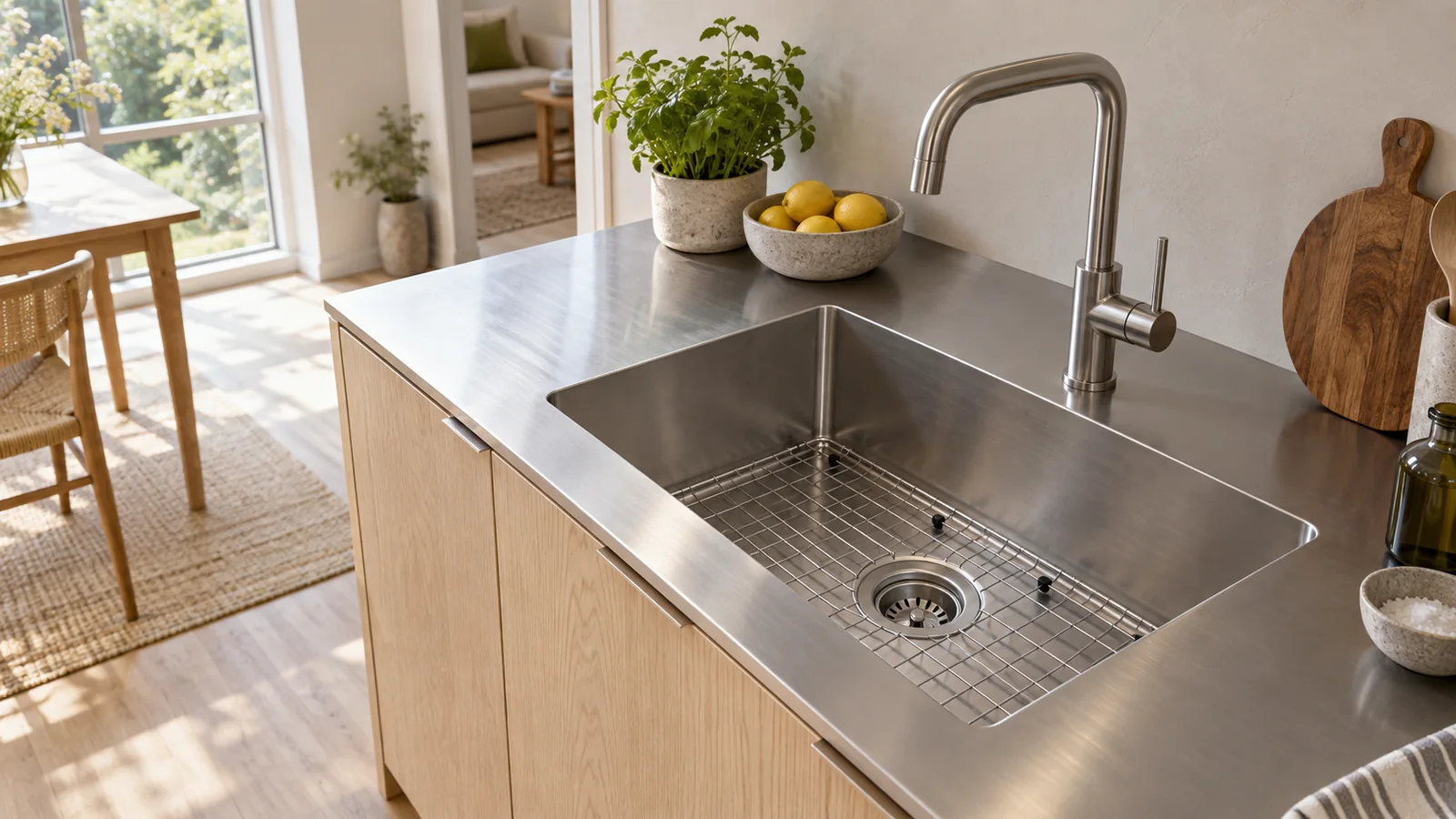
Before adding a bottom grid to the sink order, picture cleaning the bowl with it in place. You will need to lift it out, put it somewhere and clean around its feet. Whether that is worth doing depends on how you wash up.
This guide concerns a removable rack sitting near the bottom of a residential sink. It is different from a rack spanning the rim for drying dishes. The latter uses a different support position and is covered in our guide to integrated drainboards and removable drying racks.
What does a bottom grid actually change?
A grid gives pots and dishes a raised place to rest rather than placing them directly on the bowl floor. For example, BLANCO describes its sink grids as custom-fitting accessories with protective feet and side bumpers. That description is useful because the accessory is a fitted part with contact points, not simply a rectangle of wire.
What would you put on it? Perhaps a roasting tray between rinses, or a few dishes waiting to be washed. If you usually fill the bowl to wash cookware, consider whether you would leave the rack in or remove it first.
Do not use a grid as a reason to promise a scratch-free sink. It does not cover the bowl walls, and its suitability depends on its own condition and fit. Cosmetic expectations should be agreed separately from the accessory choice. A household comfortable with normal surface wear may prefer the simplest possible empty bowl.
Will cleaning it become another chore?
The grid adds surfaces and small contact points to the cleaning routine. The practical question is whether you will lift it out when the sink needs cleaning. A rack that is awkward to remove is unlikely to become more convenient after the kitchen is finished.
Kraus accessory-care guidance describes cleaning with mild soap, rinsing and drying. It also distinguishes dishwasher-safe accessories and gives instructions for protective parts on its grids. Follow the instructions for your own accessory; a metal appearance alone does not establish dishwasher suitability.
Before buying, walk through a complete cleaning cycle using a sample or the proposed product:
- Lift the grid without forcing it past the tap or scraping the bowl.
- Find a place to put it while you clean the exposed sink.
- Reach both sides of the wires and the areas around the feet.
- Check whether protective pieces can be inspected and replaced as specified.
- Return the grid without losing small parts or obstructing the drain fitting.
If your only spare counter area is the main preparation surface, include that inconvenience in the decision. A large single grid may fit the sink neatly but be awkward to handle elsewhere. A split arrangement is worth considering only if the sink and accessory supplier offer a suitable design; it should not be improvised by cutting a rack.

How do you check fit in a custom integrated bowl?
Start with the finished bowl drawing, not the outside worktop dimensions or the sink cabinet width. Those measurements do not describe the space available at grid height. A bowl can have curved internal corners or sides that change the usable outline lower down.
Ask the supplier to identify which measurements the grid drawing uses. Mark its overall outline, the position of each protective foot, the drain opening and any side bumpers. Compare those features with the bowl and the selected waste fitting. A rear-positioned drain needs a matching accessory arrangement, not an assumed central opening.
Then check use as well as geometry. Can you reach the strainer or stopper normally? Does the largest pan sit securely without resting partly on a curved bowl wall? Can the grid come out after the mixer is fitted? These are acceptance checks to agree with the supplier, not universal clearance figures.
If the bowl is being fabricated to order, request confirmation of how the grid fit will be verified against the finished bowl. A nominal size match is not the same as that check. Our article on tight and rounded sink corners explains another part of this decision: the internal shape affects access and cleaning, even when two bowls have similar headline dimensions.
When is a grid worth ordering?
It is a reasonable option when you can name a regular task it improves, the proposed cookware sits well on it, and the removal routine is acceptable. It is less compelling when the household wants an unobstructed bowl and expects to take the grid out for most tasks.
Consider two possible households. One often rinses a large pan and wants to rest it inside the sink between stages. Another fills the bowl for hand-washing, empties it, wipes it and wants nothing left inside. Neither example proves that grids are generally good or bad. They lead to different accessory choices.
If you are undecided, ask whether you can order the fitting accessory later. Keep its approved drawing and part reference: an off-the-shelf rack may not match your custom bowl, and a photograph will not supply the missing dimensions.
What should the sink order include?
List the grid separately from the integrated sink and worktop, including whether it is supplied, optional or excluded. Record the agreed finish, protective contact parts, drain alignment and cleaning instructions. Ask who supplies replacement feet or bumpers and whether availability has actually been confirmed.
The approval should also say what will be checked before shipment. If a fit check is included, define it: placement in the finished bowl, access to the waste fitting and normal removal. Do not label an accessory compatible merely because it appears beside the sink in a quotation image.
For an Anray kitchen, provide the bowl and accessory references with the kitchen plan. The customer arranges local site measurement and installation. Keep the grid as a separate, explicit choice on the order so both the factory and installer know what is included.
Review the project before production
Send your kitchen plan, destination country and local installation arrangements for a preliminary specification review.