Blog / Systems
Systems · Buyer guide
Welded-In or Undermount Sink for a Stainless-Steel Worktop?
The short answer
A welded-in sink makes the bowl part of the stainless-steel worktop assembly. A separately undermounted sink has a sealed mounting interface beneath the opening. Compare the finished junction, the fabricator’s approved construction and future access. Either arrangement needs a connection detail accepted for the particular bowl and worktop.
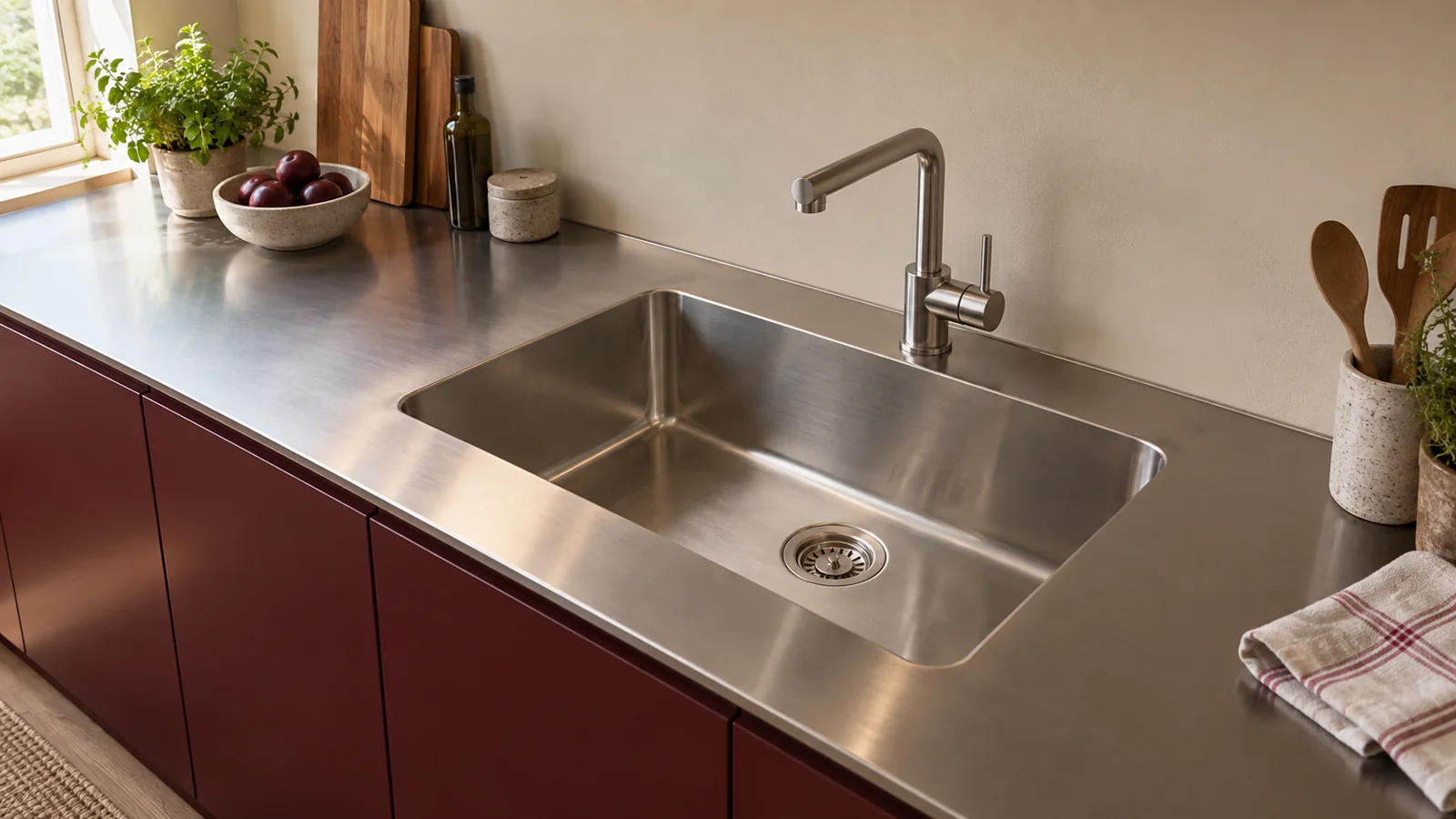
Both arrangements can suit a residential kitchen with decorative cabinet fronts and a stainless-steel working surface. The bowl-to-worktop connection determines which fabrication, sealing and access details you need to approve.
Are “integrated” and “undermount” describing the same thing?
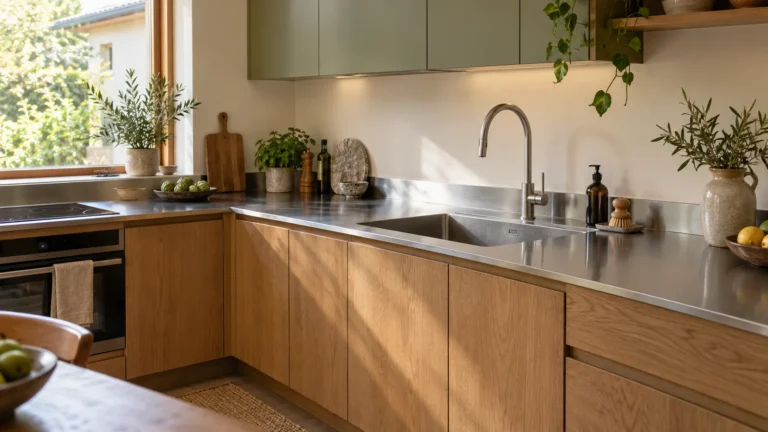
Not necessarily. In this article, “integrated” means a bowl welded into the stainless worktop and finished as part of that assembly. “Separately undermounted” means a bowl fixed below the opening with its own mounting and sealing detail.
The terms are easy to confuse because a product sold as an undermount bowl may sometimes be selected by a fabricator for a welded installation. Once welded in, it is no longer a separately removable undermount installation merely because that word appears in the original catalogue.
That distinction appears in a homeowner discussion about stainless counters and in a residential buyer’s question about which purchased sink can be welded into a custom top. Treat the discussions as evidence of confusing terminology, not approval to modify a particular product. Homeowner mounting discussion; Custom-kitchen buyer’s question.
What changes at the bowl-to-worktop junction?
Foster documents welded/integrated sink solutions within its stainless worktop offering. Franke describes a separately undermounted sink as attached beneath the countertop. These establish different construction approaches; neither source approves every possible combination of sink, steel top and support. Foster integrated installation; Franke mounting terminology.
| Decision | Welded-in bowl | Separately undermounted bowl |
|---|---|---|
| Connection to approve | Welded junction and finished transition | Opening edge, mounting detail and sealed perimeter |
| Sample to request | Representative finished bowl-to-top junction | Representative opening and rim relationship |
| Fabrication input | Bowl compatibility accepted by the worktop fabricator | Sink installation instructions accepted for the proposed top construction |
| Future access question | How can the integrated assembly be assessed or serviced? | Can fittings and mountings be reached and the bowl removed? |
| Accessory check | Confirm the fabricated ledge and accessory interface | Confirm the installed reveal does not obstruct accessories |
“No visible join” is an appearance requirement, not evidence that the entire kitchen has no joints or potential water-entry points. Faucets, drains and other connections still need their own agreed details.
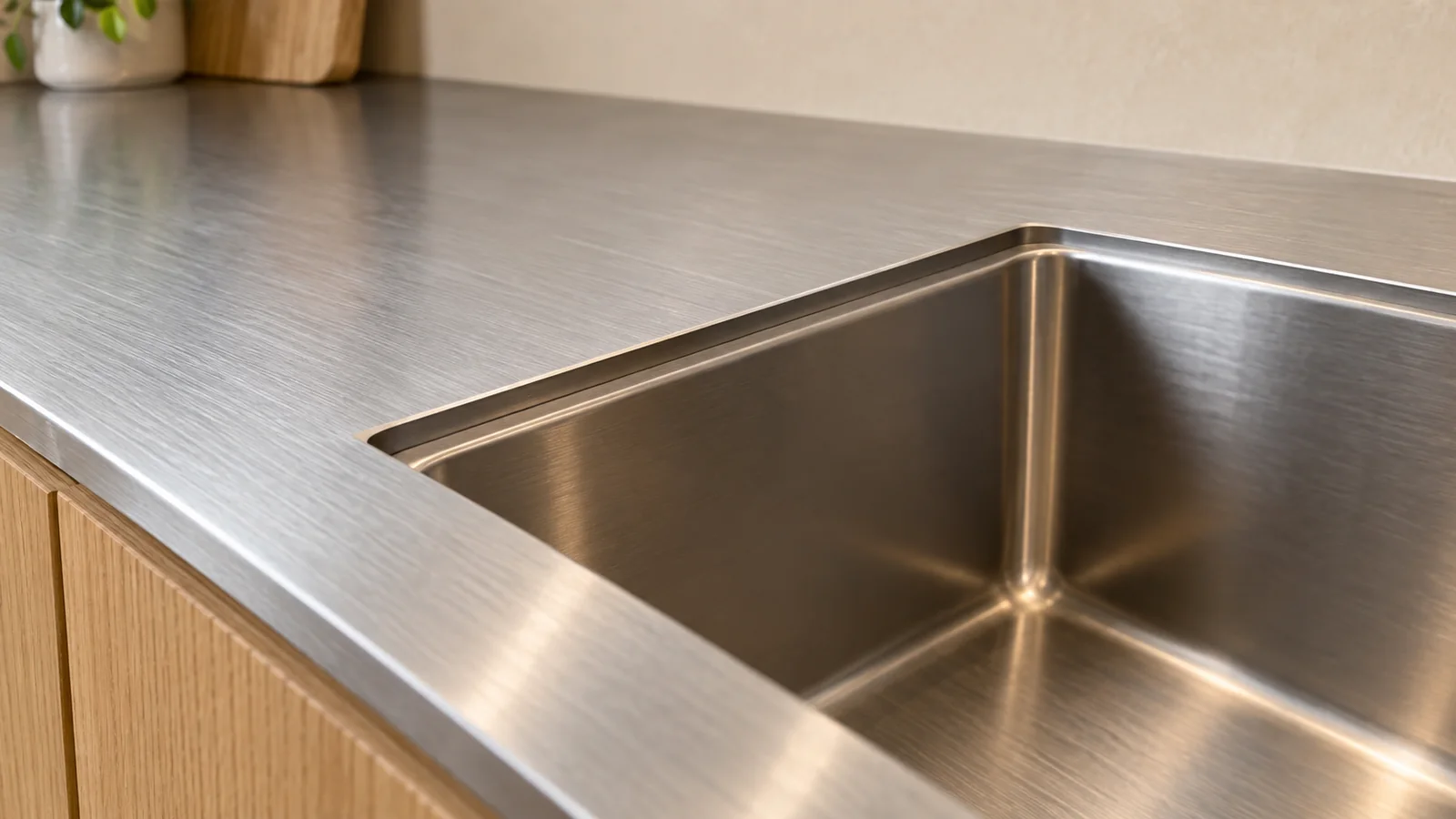
Can a separate undermount sink fit a stainless-steel worktop?
Do not answer from the surface material alone. Ask the worktop fabricator and sink supplier to approve a section through the actual assembly. It should show the exposed steel edge, any backing, the bowl rim, support, mounting access and the specified seal.
A detail intended for a thick stone countertop should not be assumed to work unchanged in a thin metal-skin assembly. Likewise, the visible edge thickness of a steel worktop does not identify its structural build-up. Review the sheet, edge and assembly thickness guide before treating an illustration as an installation instruction.
If either supplier cannot accept the proposed interface, pause that combination. The practical alternative may be a different sink, a revised worktop detail or a welded-in solution confirmed by the fabricator. Anray availability for any of these routes must be checked against the project scope.
Check the reveal before ordering accessories
The reveal is the relationship between the countertop opening and the sink’s upper edge. A countertop that projects inward over the bowl can affect access to an accessory ledge.
Kraus explicitly warns against a negative reveal for its KWU110-27 because the workstation accessories would not fit. That warning belongs to that model, but it illustrates why accessory compatibility must be checked after the mounting detail is chosen, not merely against the sink’s overall width. Kraus model-specific reveal warning.
For a custom bowl, put the exact board, rack or colander and its support detail on the approval list. Do not order an accessory based only on a similar-looking photograph.
Which route fits the project better?
Consider a welded-in bowl when the continuous metal transition is an important part of the design and the fabricator has accepted the complete bowl-and-worktop specification. Approve the finish at that junction, not just a flat steel swatch.
Consider a separate undermount when retaining a separately mounted component matters and the suppliers can provide an accepted support, sealing and access arrangement. Removability is a condition to demonstrate, not a guarantee: surrounding cabinetry, services and the opening can still restrict the work.
For an already damaged integrated bowl, use the welded-sink repair and replacement guide. This purchase comparison does not prescribe site cutting or welding.
Who approves the final connection?
Before production, assign acceptance of the worktop detail to the fabricator and confirmation of site fit and connections to the local installation team. Record which party supplies the bowl, mounting parts and specified seals, and who checks the completed installation.
For an imported residential kitchen, the customer’s local partner handles final measurement and installation. Anray’s drawings, production, QC, identified packing and remote support follow the agreed project scope.
Review the project before production
Send your floor plan, destination country and project quantity for a preliminary specification review.