Blog / Systems
Systems · Buyer guide
Drawers or Pull-Out Shelves for Stainless-Steel Kitchen Cabinets?
The short answer
Choose drawers with their own fronts for frequently used cookware when one-step access matters. Choose shelves or internal pull-outs where tall items, adaptable spacing or a continuous door appearance matters more. Decide from usable internal dimensions, opening clearance and the specified hardware, not the cabinet width or the number of storage accessories.
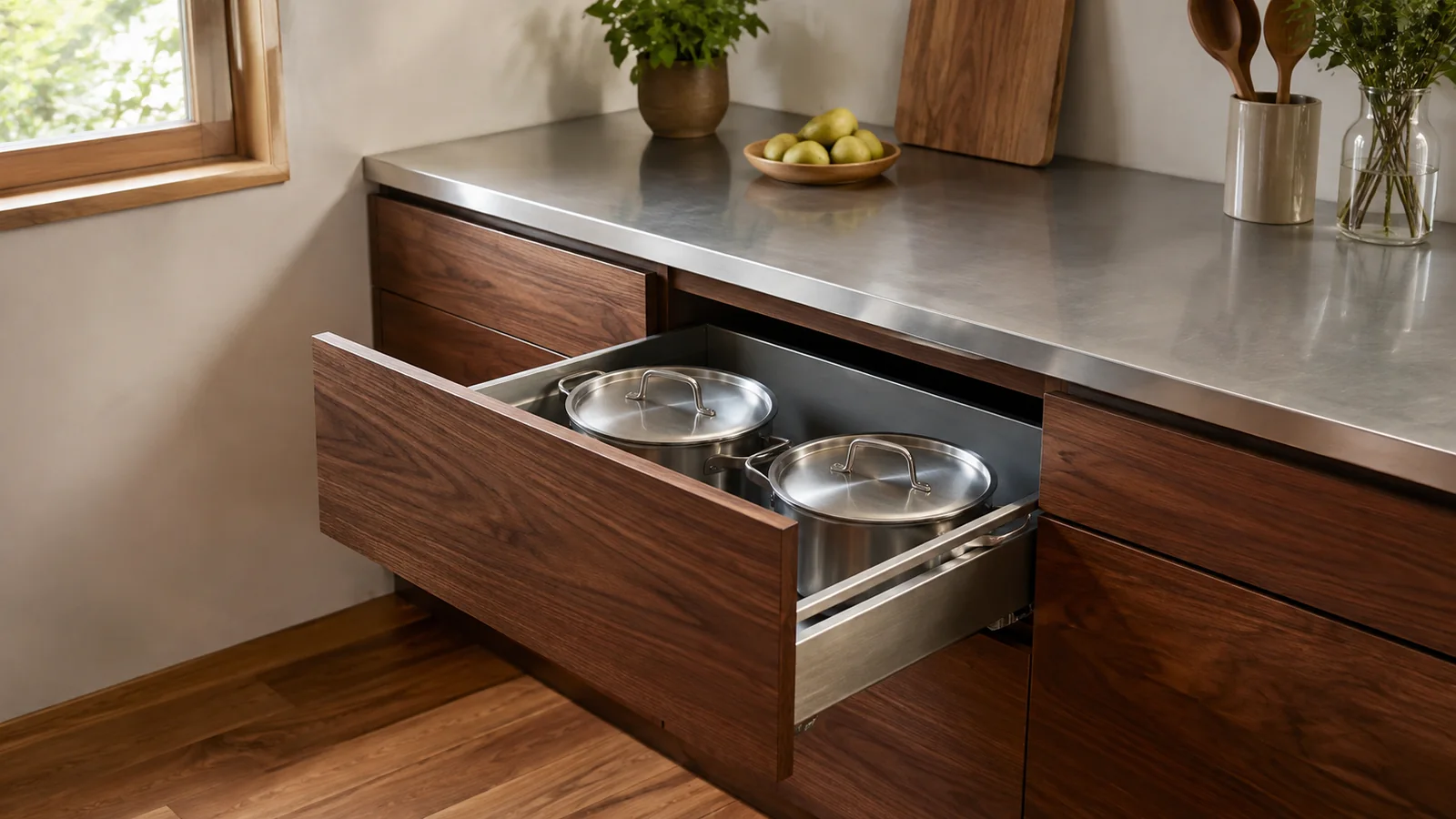
A cabinet can look generous on a drawing and still make everyday cooking awkward. The pan you use every night sits behind two other pans. A tall appliance fits the cabinet but cannot pass the drawer opening. An internal basket is convenient until its door blocks the dishwasher.
These are storage-planning problems, not reasons to choose a different door colour or abandon stainless-steel cabinetry. The residential fronts can remain timber-look, white, grey or another approved finish while the storage behind them is planned around the household.
Start with what must come out of the cabinet
Homeowners in a Houzz discussion about drawers and roll-outs compare direct access with having to open doors first. A separate discussion about lost drawer space questions the gap between external cabinet size and usable storage. Those two concerns give a better starting point than choosing the largest number of accessories.
Make a short inventory of the items that determine the layout: the widest frying pan including its handle, the tallest pot with its lid, plate stacks, chopping boards, baking trays and small appliances. Record how often each is used and where it is used. Empty accessory baskets are not an adequate fit test.
Compare the opening sequence, not just the appearance
| Storage format | Useful when | Check before choosing |
|---|---|---|
| Drawer with its own front | Frequently used contents need direct access | Internal height, extension and the space occupied when open |
| Pull-out behind a hinged door | A continuous door appearance matters | Door opening angle, hinge clearance and the extra opening step |
| Adjustable shelf behind a door | Tall or infrequently used items need adaptable space | How items at the back will be reached and removed |
Our planning recommendation is to give the easiest access to the most frequently used items, then use simpler storage where it remains convenient. That usually produces a more useful brief than insisting on all drawers or all baskets.
Ask for usable dimensions
Request clear internal width, usable front-to-back depth and usable height for each proposed drawer. Also ask for the opening through which an item must pass. The face height is not a reliable substitute for the height available inside, especially with an internal tray or an appliance above.
As one manufacturer example, Blum’s TANDEMBOX range includes drawers and interior roll-outs in different heights and describes its drawers as full extension. This illustrates why the actual hardware reference matters. It does not mean Anray supplies this range as standard, or that every metal drawer has the same extension or capacity.
For a pan drawer, try the intended arrangement with handles and lids included. For a small appliance, check the path needed to lift it out, not just whether its rectangular footprint fits. If a device will be operated inside a cabinet, obtain its ventilation and use requirements separately; storage suitability is not permission to operate it there.
Keep the sink cabinet on a separate drawing
The sink bowl, waste outlet, tap hoses, filters and any waste system compete for the same interior. In its sink-cabinet planning guidance, BLANCO describes both door-based and pull-out waste systems and stresses organising hoses so they do not obstruct moving storage. Treat product dimensions as model-specific.
Ask the kitchen designer to draw the bowl and services in section before promising a full-depth drawer under them. Mark access to shut-off valves and serviceable connections. Storage that looks efficient but must be dismantled for a routine service visit may not be the right compromise.
Specify the complete drawer, not a headline load number
When a quotation mentions a load rating, ask which component or assembly it describes, what loading conditions apply and how it is fixed to the proposed cabinet. Record the drawer size, runner model, front construction and required mounting detail. Stainless-steel cabinet walls do not remove the need to verify the hardware connection.
Avoid choosing by a vigorous showroom slam test. Instead, ask to see a representative drawer operated with the intended contents, inspect alignment and confirm what adjustment and replacement information will be supplied. The cabinet quality guide explains the broader inspection process.
Test the kitchen as a group of moving parts
- Open the dishwasher and the nearby storage in the proposed plan.
- Check whether a corner drawer meets a handle or an opposing front.
- Confirm that an internal pull-out clears its hinges and door.
- Identify where a second person can stand while a wide drawer is open.
- Make sure the items used together can be retrieved without emptying another compartment.
These are acceptance questions for the layout, not universal dimensions. The local designer and installer should validate the actual room and chosen hardware.
Do more accessories always make a better kitchen?
No. A useful accessory solves a named storage or access problem. Before approving it, identify what will go in it, confirm the usable space and agree how it can be adjusted or replaced. Put that information into the quotation comparison so a simpler but well-planned cabinet can be compared fairly with a heavily accessorised one.
Review the project before production
Send your floor plan, destination country and project quantity for a preliminary specification review.