Blog / Applications
Applications · Specification guide
How to Specify Stainless Steel Outdoor Kitchen Cabinets for Coastal Villa Projects
The short answer
For a coastal villa, specify the outdoor kitchen as a coordinated room-and-site system, not as a cabinet box selected from a catalogue. Assess exposure first, then review grade, finish, drainage, appliance interfaces, access, local measurement and installation responsibilities before requesting a quotation.

An outdoor kitchen has to work as part of the architecture and the project handoff. The cabinet material matters, but it is only one decision in a chain that also includes rain, salt exposure, surface finish, appliance cut-outs, worktop interfaces, local installation and maintenance access.
Start with exposure, not with a stainless-steel grade
The first question is not simply “304 or 316?” It is where the kitchen sits and what reaches it. A covered terrace beside the sea, a fully exposed pool deck and a humid secondary kitchen may need different specifications even when they use the same cabinet family.
Record the conditions that can change the brief:
- Distance from open water, surf, salt spray or a chlorinated pool environment.
- Whether the kitchen is fully exposed, partially sheltered or protected by a deep overhang.
- How rainwater leaves the worktop, cabinet base and surrounding floor.
- Heat, humidity, wind-blown dust and the frequency of cleaning.
- Whether the visible surfaces can be reached for inspection and maintenance.
The British Stainless Steel Association identifies chloride exposure, site environment, surface finish, orientation, natural rain washing and maintenance as relevant inputs for external stainless-steel selection. It also notes that marine locations can be more aggressive because of chloride exposure. Read the BSSA exterior-application guidance.
Use 304 and 316 as conditional choices, not marketing labels
Type 304 is widely used across kitchen and architectural applications. Type 316 includes molybdenum and generally offers better resistance than Type 304 in chloride environments. That does not make 316 a universal answer: the site, geometry, finish, fabrication quality, cleaning plan and exact exposure still matter.
For a project review, ask the supplier to explain:
- Which grade is proposed for cabinet bodies, doors, worktops, fasteners and other exposed components.
- Whether the proposed grade applies to the full assembly or only to selected visible parts.
- What evidence supports the stated grade, such as a current material certificate or approved BOM entry.
- How the proposal changes for direct marine exposure, poolside conditions or a sheltered inland terrace.
- What cleaning and maintenance assumptions are included in the recommendation.
External selection guidance is a decision aid, not a substitute for site-specific engineering or local compliance review. Do not turn a general 304-versus-316 explanation into a promise that a particular cabinet will never stain, pit or corrode.
Review the interfaces where outdoor cabinet problems begin
A specification should make the difficult interfaces visible before production. Look beyond the front finish and review the places where water, heat, dirt, hardware and movement meet:
- Worktop-to-cabinet interface: confirm the worktop material, overhang, joints, sink cut-out and how water is prevented from collecting at the cabinet edge.
- Cabinet base: confirm the floor condition, levelling method, access for cleaning and the route for any water that reaches the lower zone.
- Doors and drawers: confirm hardware specification, clearances, alignment requirements and whether replacement parts can be identified later.
- Joints and welds: confirm the fabrication standard and how visible surfaces will be finished after fabrication.
- Mixed materials: confirm how stainless steel meets stone, timber, painted panels, tile, sealants and other metals.
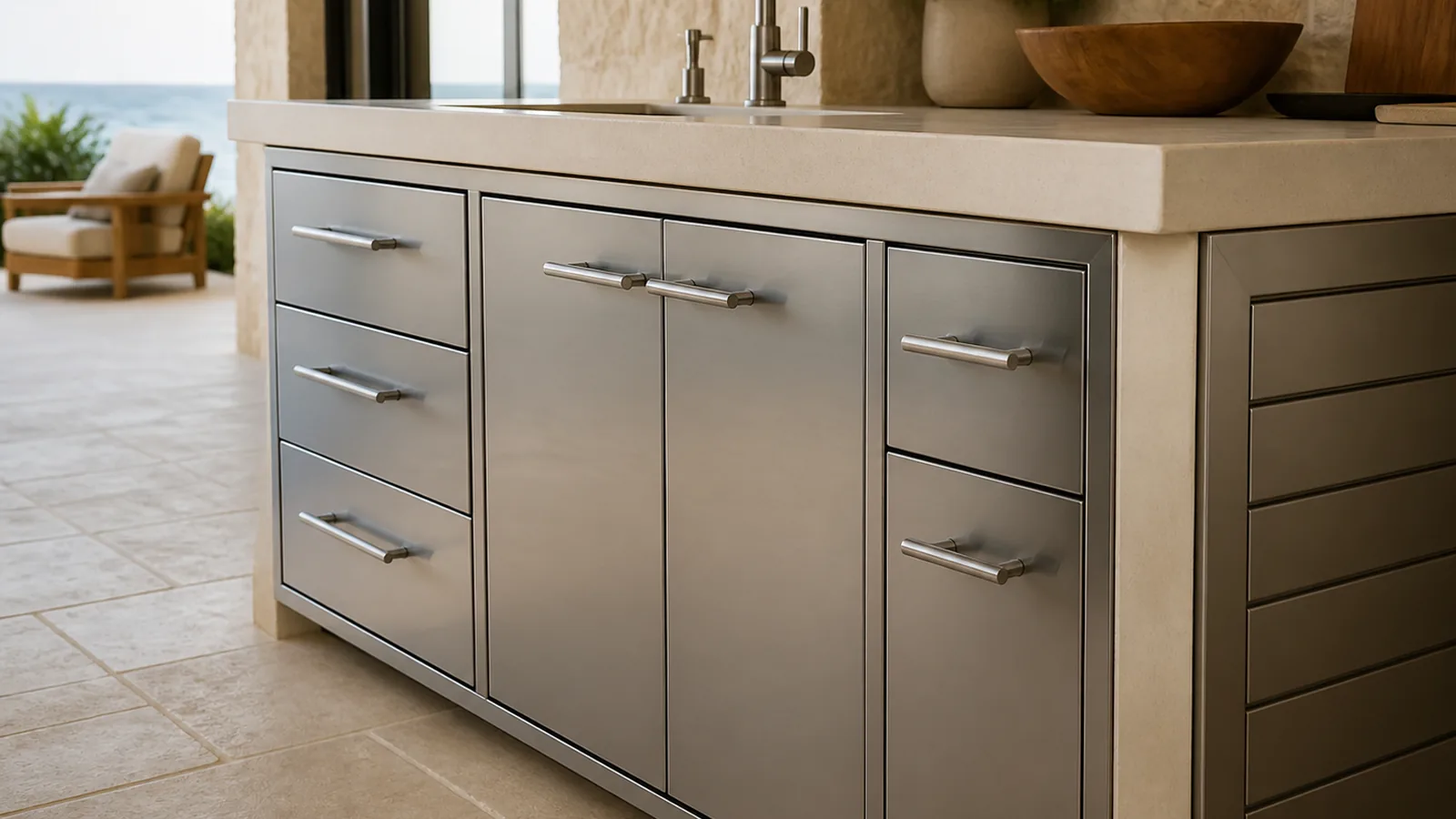
BSSA guidance also highlights the importance of surface finish, fabrication, free drainage and avoiding contamination during storage and erection. The practical lesson for a buyer is simple: a material grade on a quotation cannot compensate for an unclear interface or an uncontrolled handoff.
Coordinate appliances and local installation before pricing
Outdoor kitchen cabinets are usually built around appliances, services and site dimensions. A supplier needs more than a style reference to price the work responsibly.
Resolve these items in the drawing set:
- Final appliance models or confirmed opening dimensions.
- Gas, electrical, water and waste connection points, with local code responsibility identified.
- Worktop thickness, finished height, overhangs and sink or cooktop cut-outs.
- Wall, floor and adjacent finish conditions that affect fillers, panels and end returns.
- Access route, packaging constraints, assembly sequence and who performs final local measurement.
- Who owns installation, commissioning, local adjustments and after-sales service.
Anray’s published process is built around the room brief, appliance interfaces, a controlled project file, production, packing and local installation handoff. See the project process. This is a coordination route; it is not a claim that Anray provides local measurement or turnkey installation in every country.
Send a quotation package that a supplier can actually use
A useful RFQ package reduces guesswork and gives the supplier a clear boundary for the first review. Include:
- Floor plan, elevations or a dimensioned sketch.
- Project country, city and intended delivery point.
- Outdoor exposure description and whether the kitchen is covered.
- Cabinet run lengths, island dimensions and preferred worktop level.
- Appliance schedule with model numbers where available.
- Preferred grade, finish and hardware only if these are already specified; otherwise ask for a conditional recommendation.
- Target quantity, project phase, required quotation date and expected installation window.
- Local measurement, importing, installation and after-sales responsibilities.
A supplier should be able to tell you which assumptions are confirmed, which are provisional and which items could change the price or production route. If the quotation cannot show those boundaries, the apparent low price may simply reflect missing scope.
When a preliminary project review is useful
Anray can review a real project file at the preliminary stage: room plan, destination country, project quantity, appliance information and the local team’s measurement and installation route. The review can identify missing inputs and clarify what needs to be confirmed before a technical quotation.
For trade buyers, the relevant question is not whether a supplier can show a polished cabinet image. It is whether the supplier can keep the room, drawing, BOM, packing and local handoff aligned through the project.
General information only. Stainless-steel grade, thickness, finish, hardware, compliance, warranty and installation scope must be confirmed for the specific project and destination market.