Blog / Project Process
Project Process · Buyer guide
Does a Stainless-Steel Worktop Need Protection from Dishwasher Steam?
The short answer
Check the dishwasher instructions and the complete worktop assembly. A visible stainless-steel surface does not establish what sits beneath it or how neighbouring decorative fronts are protected. Agree any specified barrier, ventilation and opening clearances with the appliance supplier and installer; do not assume that a steel top makes every adjoining component steam-proof.

The top surface may be steel while the underside, edge assembly and adjoining fronts have different materials and details. Before deciding that a dishwasher needs no steam protection, ask what is exposed when the door opens and which instructions govern that installation.
This is a domestic kitchen interface review, not a repair diagnosis for a leaking appliance. Unexpected leakage, damaged electrical parts or steam escaping from an abnormal location should be referred to the appliance service provider. Do not cover an unexplained fault with tape and continue treating it as normal operation.
Why the steel surface is not the whole assessment
A visible stainless worktop does not identify its complete construction. Ask the manufacturer to describe the agreed underside and front-edge detail above the dishwasher. Include any support, joint and adjoining decorative fronts in the review, without assuming a particular core or bonding system.
IKEA’s diffusion-barrier guidance discusses protection for laminate and wood-veneered worktops above appliances. That is evidence that the surrounding construction matters; it does not establish the correct barrier for every stainless-steel assembly.
For a steel-topped kitchen, give the installer both the worktop construction information and the appliance instructions. Ask for a written decision on the underside and neighbouring fronts. A generic claim that steel tolerates heat cannot answer whether a different adjoining component is protected in this arrangement.
Use the appliance instructions to decide on a barrier
Record the exact dishwasher model and market version. Have the installer identify the supplied or specified protection, its position and any relevant worktop conditions. Keep the installation document with the kitchen record rather than relying on a photograph of another brand’s machine.
Bosch sells a named 00114294 vapour barrier plate and provides an appliance model compatibility check. A manufacturer’s accessory is a starting point for model verification, not permission to fit that part to any dishwasher or worktop.
Check whether the chosen protection is permitted for the actual appliance and supporting materials. Ask who supplies it, who installs it and who checks the completed placement. Do not substitute an unrelated foil, adhesive film or deflector because a forum commenter found it useful in a different kitchen.
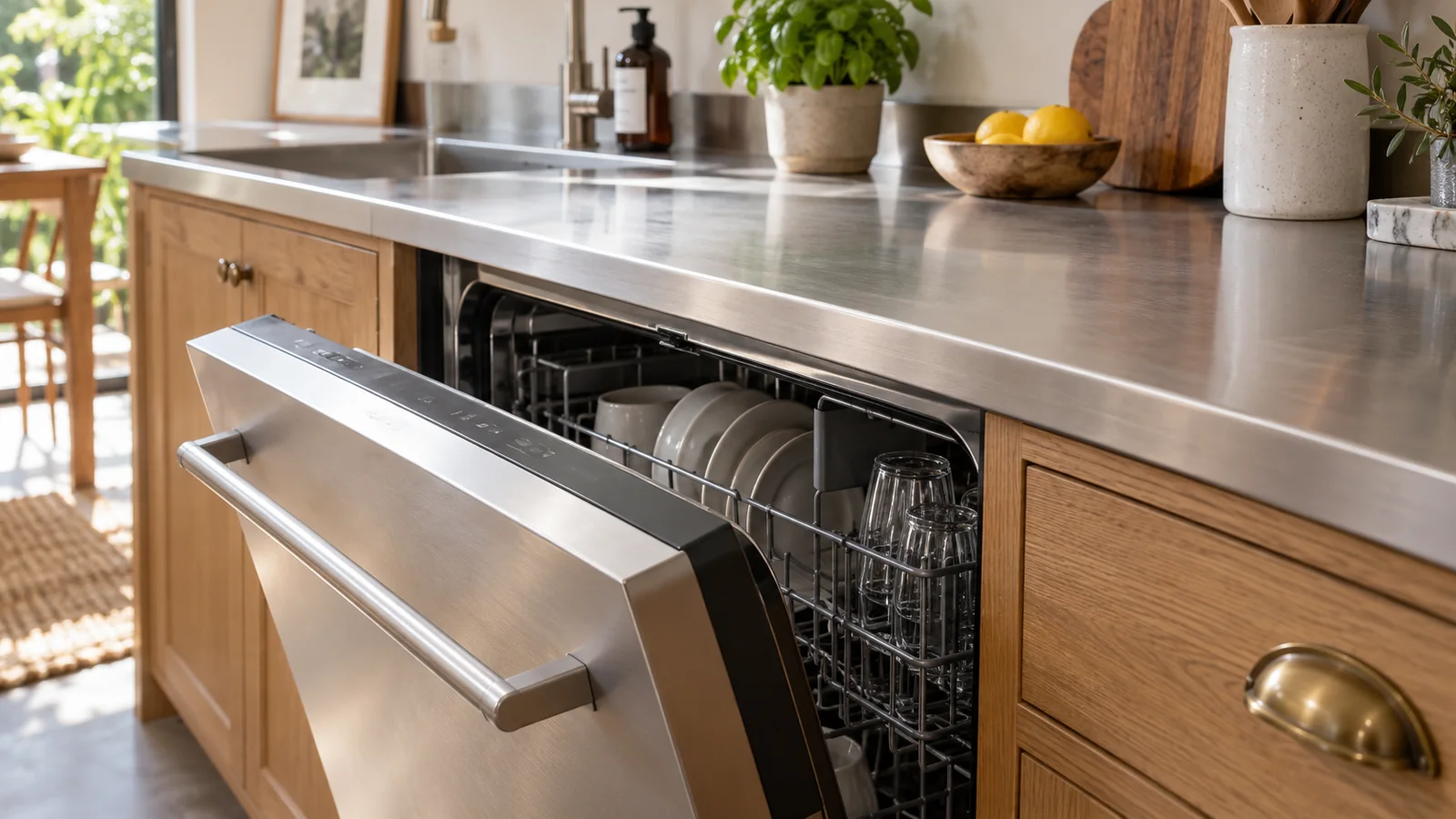
Map the exposed edge and adjoining fronts
Review the top edge of the dishwasher opening, the worktop lip and nearby door or drawer fronts. Include any filler, end panel or handle that projects into the opening area. Photograph the door closed and in its intended open positions so the relevant parties can see what is close to the appliance.
The factory drawing should distinguish manufactured parts from local installation items. If a barrier is applied on site, identify its location and owner in the installation notes. Do not assume it will be included in the cabinet package just because the appliance manual requires one.
- Exact dishwasher and decorative-front model or specification.
- Complete worktop underside and front-edge construction over the opening.
- Specified protection and its application instructions.
- Door movement, adjoining reveals and any model-specific ventilation requirement.
- Access for inspecting and removing the appliance later.
Space and mounting questions are covered in our dishwasher fit guide. This article adds the moisture-exposure review; it does not replace the appliance’s installation instructions.
What if the dishwasher opens automatically?
Tell the kitchen designer and installer before they approve the interface. Ask them to review the model’s intended opening action alongside the worktop and front details. Use the manufacturer’s operating instructions to decide which settings and user actions are appropriate.
Do not assume that every automatic-opening machine damages cabinets, or that every machine uses the same protective arrangement. Equally, do not disable or obstruct a feature as a default design solution without asking the appliance supplier about that model. Record the agreed operating guidance in the handover pack.
If a problem appears only after a cycle, describe the timing and location to the service provider. Distinguish dampness at the worktop edge from water beneath the appliance and from an already damaged decorative front. These observations help an inspection but do not establish the fault.
Handle an existing damaged edge in the right order
Start with a record of the appliance model, installation and visible damage. Ask the relevant parties to determine whether the source of exposure has been addressed before planning a cosmetic repair. Replacing a front or applying a barrier without resolving the cause can leave the owner with the same unanswered question.
The worktop manufacturer should identify its permitted repair options. The decorative-front supplier should assess the front separately. A steel-surface cleaning method cannot be assumed suitable for every coated or wood-look component in the opening.
If a component needs replacement, retain its cabinet or panel identification and approved finish reference. Our front repair and replacement guide explains the documentation needed to discuss a matching part.
A useful acceptance record
Have the appointed installer confirm completion against the appliance instructions, including any specified protection. Retain photographs before the machine obscures the underside and a record of unresolved conditions. Commissioning should follow the appliance supplier’s instructions; this article does not propose an improvised steam test.
For an imported kitchen, you appoint the local measurement and installation team. Anray’s manufacturing review covers the agreed kitchen parts and interfaces; Anray does not provide a local installation team or certify an appliance installation remotely.
Common questions
Is stainless steel automatically enough protection?
Assess the complete assembly and adjoining materials against the actual dishwasher instructions. Appearance alone cannot establish the underside construction or required installation detail.
Should I buy a barrier before choosing the dishwasher?
Confirm the exact model first. Its instructions and compatibility information should guide the part selection and installation review.
Can I treat unexpected steam as harmless because the top is steel?
No. Report abnormal operation or leakage to the appliance service provider and have it assessed separately from the worktop-material question.
Review the project before production
Send your floor plan, destination and the exact equipment drawings for a preliminary kitchen-interface review. You appoint the local measurement and installation team; any manufacturing detail remains subject to the agreed drawings and scope.