Blog / Project Process
Project Process · Buyer guide
How to Remove Protective Film and Adhesive from a Stainless-Steel Worktop
The short answer
Identify the worktop finish and obtain the supplier’s film-removal instructions before peeling or treating residue. Inspect and photograph the surface at the agreed handover stage. If film tears, adhesive remains or the finish changes, stop and ask for an approved method rather than escalating to blades, solvents or heat.

The kitchen is almost finished. Your stainless-steel worktop sits above painted or wood-look doors, but a strip of film will not lift cleanly. Another patch feels sticky. The immediate question is how to remove it without turning a small handover problem into a permanent mark.
Start by finding out what remains on the surface. Installation film, packaging tape and an unexplained mark need different decisions. The following handover checklist helps you agree on those decisions with the supplier.
Identify the finish and the film before choosing a cleaner
Ask the supplier for the finish description, the protective-film instructions and any restrictions on cleaners. Include the sink if it is welded into the worktop: do not assume every exposed surface has the same treatment.
Film selection depends on the application. Novacel’s industrial approval guidance calls for checking the actual surface and processing or storage conditions, then assessing residue and surface appearance after removal. That supports asking about the specific film used; it does not identify the film or adhesive on your kitchen. See Novacel’s approval guidance.
A cleaner advertised for stainless steel has not necessarily been approved for your complete assembly. Ask whether it is compatible with the finished steel, nearby door fronts, sealants and any exposed edge materials. If that information is missing, request it before treating the mark.
Agree on a film-removal point in the installation schedule
Arrange an inspection while the supplier and installer can still respond to a problem. Record who will reveal the finish, who will photograph it and what protection remains during later work.
There is a useful manufacturer example: Purus’s Original/Basic installation manual describes temporarily removing protective plastic to inspect its worktop before installation and retaining protection until surrounding work is complete. This is an instruction for those products, not an Anray removal timetable. See the Purus installation manual.
For your order, obtain the removal conditions and any storage restrictions in writing. Do not decide to leave film on indefinitely simply because decorating is delayed. If further construction protection is needed, agree on a suitable temporary system instead of assuming the original film can serve that purpose.

Describe what remains after peeling
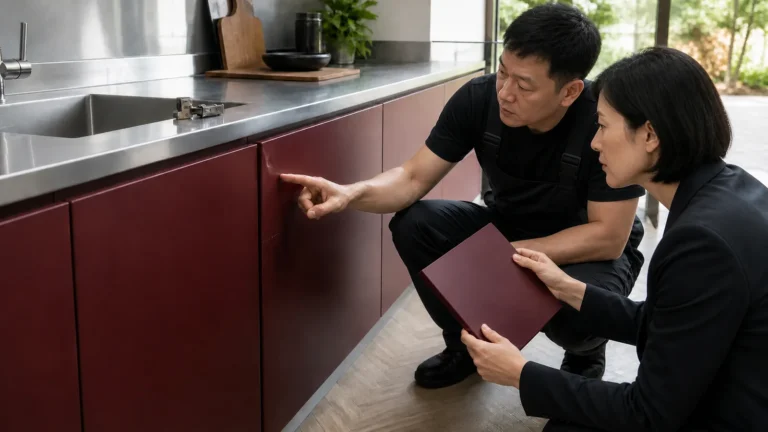
Take a wide photograph showing the location, then a close view in consistent light. Record whether the material feels raised or sticky without scratching or probing the steel. Use observations rather than a diagnosis.
| What you observe | What to record | Next question for the supplier |
|---|---|---|
| Film breaks into small pieces | Storage history, affected area and the film still attached | What removal method is approved for this film and finish? |
| A tacky patch follows a tape edge | Tape location and condition before cleaning | Is this adhesive, and which exact cleaner is permitted? |
| A dull or shiny patch has no obvious raised residue | Appearance when dry and the surrounding finish | Could this be a finish change rather than removable glue? |
| The mark changes after a cleaning attempt | Product, tool, contact time and before-and-after photographs | Should treatment stop pending inspection? |
A description such as “tacky along the tape edge” gives the supplier more to work with than “the steel looks wrong.” It still does not identify the material or justify stronger rubbing.
If the supplier confirms adhesive residue
Request a complete method: the exact product, permitted application tool, contact time, rinse or removal step, and any personal-protection or ventilation instructions. A product name without an application method leaves important questions unanswered.
Ask whether a test on a spare sample of the same finish is appropriate. If the supplier permits testing on the installed surface, agree on the location and acceptance criteria first. Check the dry appearance as well as stickiness; removing tack does not establish that the finish is unchanged.
Keep nearby cabinet fronts and joints out of the treatment area as instructed. Do not pour a cleaner across the worktop or allow it to run into an edge because the steel surface itself appears compatible.
If the approved method does not work, report the result. Avoid adding a second cleaner, increasing the contact time or switching to an abrasive tool without further approval. For a separate question about disinfectants, read our guide to bleach and stainless-steel worktops.
Why this guide does not prescribe a blade, solvent or hairdryer
An appliance owner may report success with one of these methods. Before copying it, you still need to know whether it suits your worktop finish and the surrounding materials.
Ask the supplier to assess any proposed tool or chemical for this assembly. Do not use a knife to chase an edge, polish a patch to match its neighbours or apply heat based solely on another owner’s result. None of those actions establishes what the original mark was.
If scratches or a changed sheen are already visible, leave the area available for inspection. Our worktop finish guide covers the appearance choices to discuss before ordering; it is not a repair instruction.
Keep a useful handover record
Include the panel or module reference, finish description, date of inspection, photographs before treatment, the approved procedure and its result. Separate marks present at first inspection from later construction incidents. Record uncertain timing as uncertain.
For an imported kitchen, agree on these responsibilities before delivery. The customer arranges local measurement and installation. A clear record helps the factory and local installer discuss the same component without assuming either has inspected the other’s work.
Questions homeowners ask
Can I use alcohol or a household adhesive remover?
Only if the supplier approves that exact product and method for the finished assembly. A successful result on a fridge or plain steel sample does not establish compatibility with your worktop.
Does a sticky area mean the steel is damaged?
Not necessarily. It is an observation requiring identification. Photograph it and ask for the approved next step; do not claim either damage or harmless residue from a photograph alone.
Should I remove all protection as soon as it arrives?
Follow the agreed inspection and installation sequence. Discuss delayed installation with the supplier rather than inventing a storage or removal period.
Before ordering your residential kitchen
Put finish identification, protective-film care and handover inspection into the order discussion alongside dimensions. They should be understandable to the person installing the kitchen locally.
Review the project before production
Send your kitchen plan for project review with the destination, preferred worktop finish and local installation arrangements. Ask for the protection and inspection instructions to be included in the agreed scope.