Blog / Materials
Materials · Buyer guide
Can Bleach Damage a Stainless-Steel Kitchen Worktop?
The short answer
Yes. Bleach and other chloride-containing cleaners can stain or corrode a stainless-steel worktop, especially when concentrated, warm, left in contact or poorly rinsed. Remove the product, rinse thoroughly with clean water, dry the surface and ask the fabricator before attempting abrasive or chemical restoration.
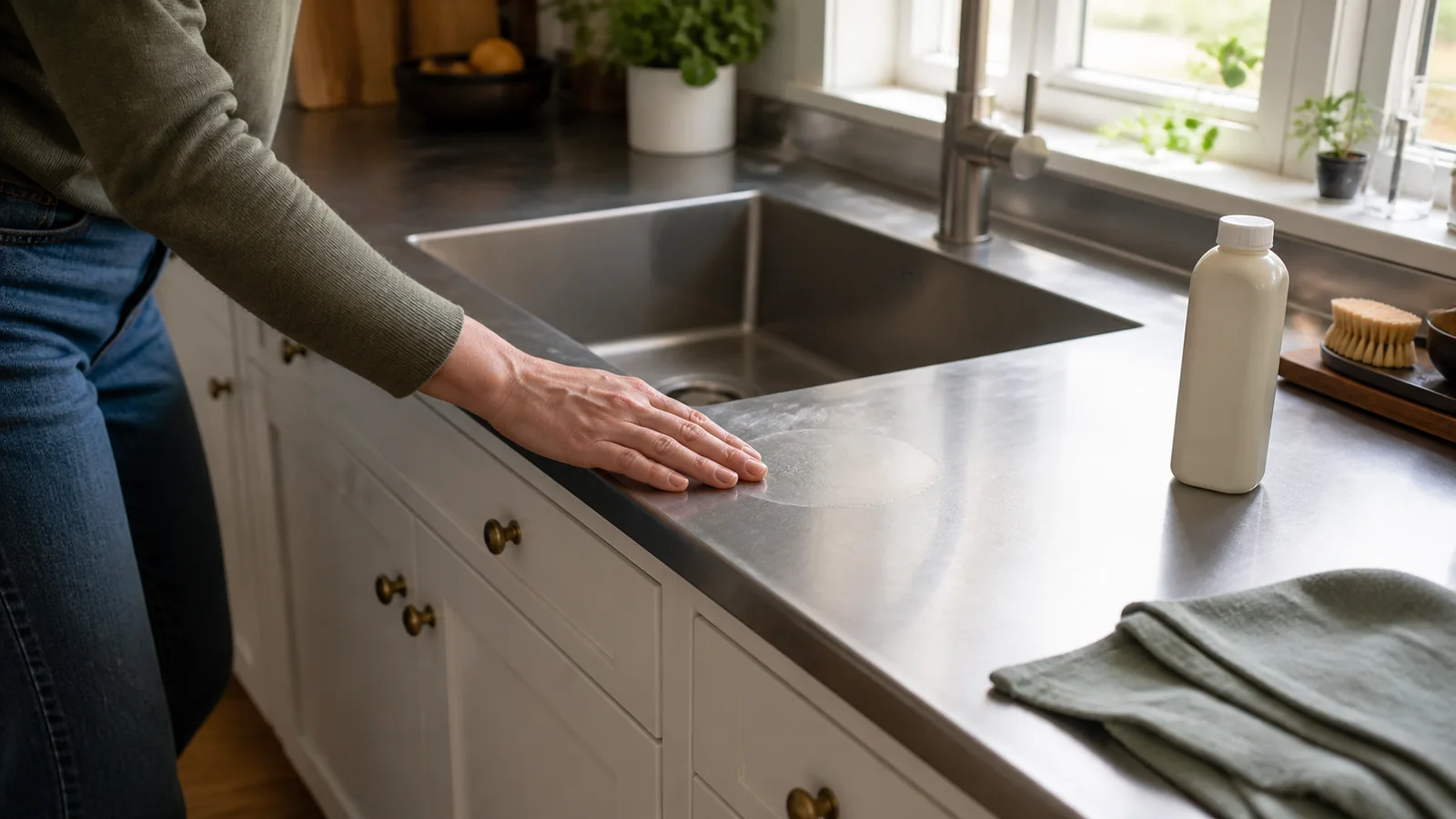
Stainless steel is corrosion-resistant, not chemically immune. In a residential kitchen, bleach can reach the visible worktop through disinfectant sprays, drain cleaners, whitening powders, soaked cloths or a leaking bottle stored under the sink. The risk is not limited to an obvious spill: residue trapped at a faucet base, sink corner or low upstand can remain wet long after the main surface has been wiped.
Why bleach is a real risk to stainless steel
Household bleach normally contains sodium hypochlorite, a chloride-bearing chemical. Chlorides can interfere with the passive chromium-rich film that gives stainless steel its corrosion resistance. Risk increases with concentration, contact time, temperature, poor rinsing, crevices and repeated exposure. A warm worktop beside a cooktop, a saturated cloth left overnight or cleaner collected around a joint is therefore more concerning than a brief, diluted contact that is immediately rinsed.
The worldstainless domestic cleaning guide warns that concentrated bleach can damage stainless steel and that diluted hypochlorite products should not remain on the surface. It also cautions against cleaners containing chlorides. This does not mean every brief exposure creates permanent damage; it means bleach should not be the default care method for the visible worktop.
Act immediately after accidental contact
- Remove the source. Pick up the bottle, cloth or pooled product without spreading it to fronts, seals or appliances.
- Rinse with plenty of clean water. Do not neutralize the bleach by improvising with another household chemical. Mixing cleaners can create hazardous reactions.
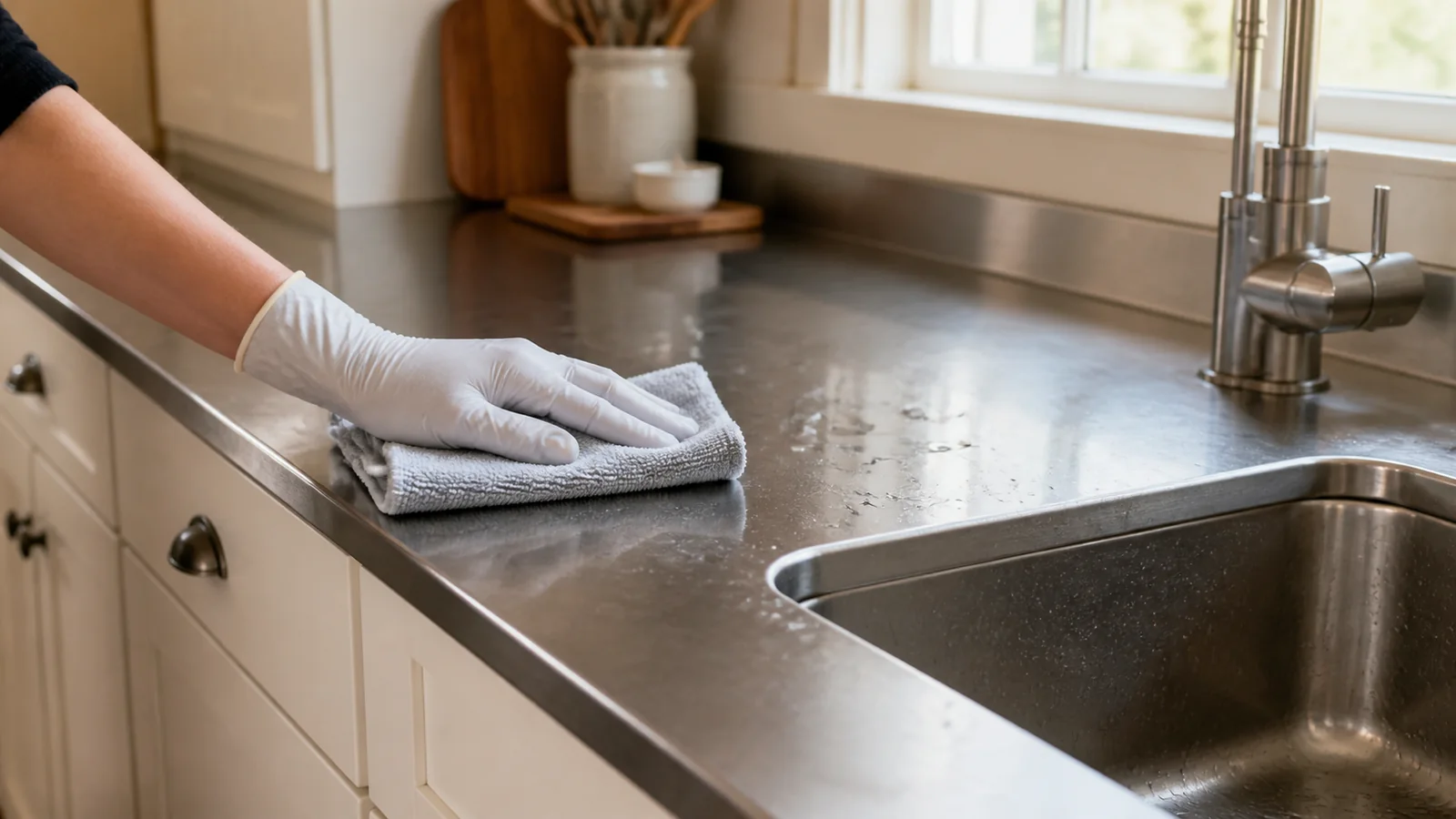
- Wash gently. Use the fabricator-approved mild detergent and a soft clean cloth.
- Rinse again and dry. Pay attention to faucet bases, sink corners, returns and the worktop-to-wall junction.
- Record the condition. Photograph the area in normal and raking light before attempting restoration.
If bleach has entered a seam, hollow edge, cabinet joint or appliance opening, tell the responsible installer. A clean-looking top surface does not prove that trapped residue has been removed from the interface.
Separate residue, finish change and corrosion
A pale haze may be dried cleaner residue. A dull or bright patch may be a changed surface finish. Orange-brown staining may come from free-iron contamination rather than the stainless substrate. Tiny dark cavities can indicate pitting. These conditions require different responses, so repeatedly scrubbing the same spot is poor diagnosis.
| Observation | Possible explanation | Next step |
|---|---|---|
| Cloudy film that changes when wet | Cleaner or mineral residue | Use the approved mild cleaning sequence, then rinse and dry |
| Uniformly dull or bright patch | Finish altered by chemical or abrasive action | Stop spot polishing and request a finish assessment |
| Brown marks without pits | Residue or external iron contamination may be present | Use the separate rust-coloured spot diagnostic |
| Small cavities or recurring dark points | Possible localized corrosion | Arrange qualified inspection; do not conceal with oil |
Use the guide on rust-coloured spots on stainless worktops when the mark is brown, orange or associated with a pit. The visual symptom alone does not establish alloy grade, fabrication quality or the cause.
Do not improvise aggressive restoration
Ordinary steel wool and carbon-steel scourers are inappropriate. They can scratch the directional finish and transfer iron particles that later rust. The British Stainless Steel Association cleaning guidance recommends mild methods first, clean rinsing and testing stronger methods away from critical visible areas. It also distinguishes ordinary cleaning from removal of iron contamination and other specific defects.
Abrasive blending is not ordinary cleaning. On a brushed worktop, grit, pressure, tool path and grain direction determine whether the repaired zone matches the surrounding surface. Treating only a coin-sized spot can leave a larger halo. On coated, coloured, patterned or bead-blasted stainless, an on-site abrasive may permanently change the surface. Ask the fabricator to identify the finish and propose a trial area before authorizing restoration.
Use a safer routine cleaning sequence
For day-to-day soil, start with warm water, mild detergent and a clean soft cloth. Rinse away detergent and dry the surface instead of allowing residue to evaporate. Wipe with the visible grain where the finish is directional. The ASSDA indoor stainless cleaning guidance recommends working with the grain and testing methods on an inconspicuous area.
- Keep bleach, hydrochloric-acid cleaners and unknown chloride products off the exposed care list.
- Do not store leaking cleaner bottles directly below an integrated sink.
- Use separate, clean cloths for the stainless surface and for other metals or masonry.
- Rinse after every cleaner rather than layering products.
- Dry low points and joints where solution can remain trapped.
If hard-water residue is the actual problem, follow the controlled method in the hard-water spot guide instead of substituting a disinfectant.
Cleaning and disinfection are different requirements
A homeowner may ask for bleach because “clean” and “disinfected” are being treated as the same objective. In an ordinary residential kitchen, the handover guide should separate routine removal of grease and food residue from any special disinfection procedure. If a project has a defined hygiene protocol, the cleaning chemical, concentration, contact time, rinse requirement and surface compatibility must be verified together. A product that is effective as a disinfectant is not automatically suitable for every stainless finish, sealant, coating or adjacent front.
Design details can reduce chemical exposure
Maintenance risk is affected by geometry. Ponding around a faucet, an unsealed penetrant, a sharp internal corner or a poorly drained sink ledge can hold cleaner. A low integrated upstand can simplify one wet-zone junction, while an incorrectly detailed transition can create another trap. Review sink drainage and residual water as part of the same system.
Specify accessible plumbing and storage under the sink so a leaking bottle or wet cloth can be detected. Residential fronts should remain easy to open for inspection; a hidden stainless inner carcass may improve cleanability, but it does not make chemical leakage harmless.
Put chemical restrictions in the handover pack
“Use stainless cleaner” is not an adequate instruction. The project handover should identify the visible finish, routine cleaner, prohibited chemicals, approved cloth or pad, grain direction, rinse and drying procedure, and the escalation contact. The accepted surface should be photographed under representative lighting.
- List bleach and chloride restrictions explicitly.
- State what to do after accidental contact.
- Identify whether the worktop is bare, coated, patterned or directionally finished.
- State when the user must stop cleaning and request inspection.
- Keep the product data and care instructions with the kitchen records.
Questions to put in the RFQ
- What stainless grade and exposed finish are proposed for the worktop and sink?
- Which routine cleaners are approved, and which chemicals are prohibited?
- What is the first-response method after bleach or chloride contact?
- Can the visible finish be blended on site, and what sample defines acceptance?
- How are cleaner traps around faucets, upstands and appliance cutouts avoided?
- Who determines whether a mark is residue, finish damage, contamination or pitting?
Bottom line
Bleach can damage a stainless-steel kitchen worktop; “stainless” does not mean immune to chlorides. Remove accidental contact, rinse thoroughly, wash mildly, dry and document the result. Do not reach for steel wool or aggressive spot polishing. The correct long-term control is a written care method, a well-drained detail and a defined route to professional finish assessment.
Review the project before production
Send your floor plan, destination country and project quantity for a preliminary specification review.