Blog / Materials
Materials · Buyer guide
Why Does a Stainless-Steel Kitchen Worktop Develop Rust-Coloured Spots?
The short answer
A brown spot does not prove that the whole worktop is the wrong grade. Common causes include carbon-steel contamination, iron-rich residue, unremoved fabrication contamination, chloride-bearing cleaners and localized corrosion in a wet crevice. Photograph the area, stop aggressive cleaning, isolate the exposure history and inspect whether the mark is removable or accompanied by pitting.
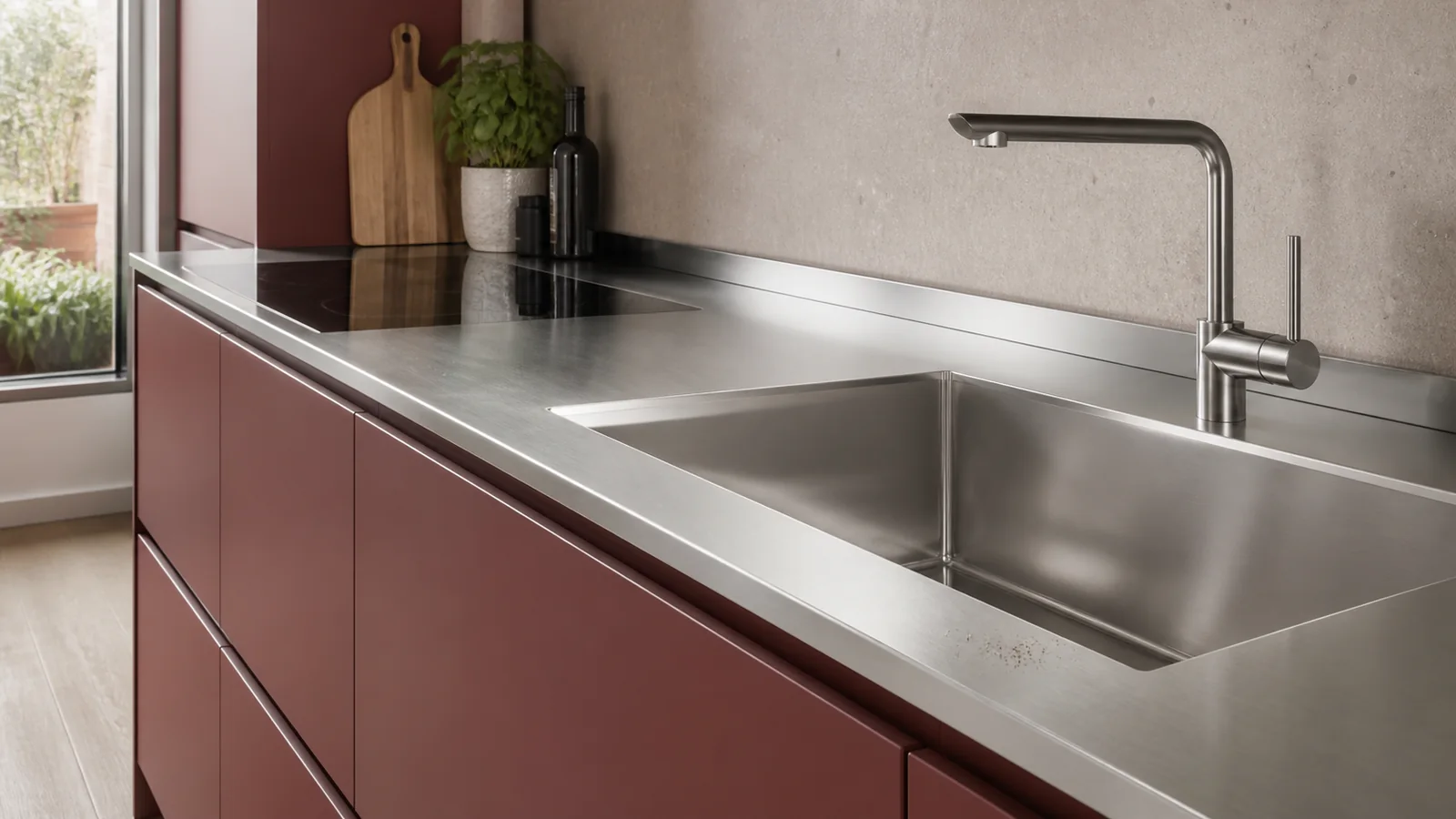
“Stainless” means corrosion-resistant, not immune to every contaminant and environment. A few brown marks on a new residential worktop can come from foreign iron, site residue, a cleaner, a wet crevice or localized attack. Those causes require different corrective actions. Rejecting the entire kitchen from a photograph is as unreliable as dismissing every mark as harmless.
Four different problems can look brown
| Possible cause | Typical evidence | First response |
|---|---|---|
| Free-iron contamination | Small rust-coloured specks after fabrication, installation or contact with carbon-steel tools | Record tool and handling history; use a competent approved cleaning method |
| Deposited residue | Iron-rich water, a can, rack, fastener or other object leaves a removable stain | Remove the source, clean gently, rinse and observe recurrence |
| Chloride or chemical exposure | Marks near bleach, hydrochloric-acid cleaner, salt or a wet cleaner trap; pits may be present | Stop exposure, rinse safely and obtain specialist advice if pitting exists |
| Tea staining or localized corrosion | Discolouration linked to an aggressive environment, rough finish, deposits, crevices or poor drainage | Assess grade, finish, fabrication, exposure and maintenance together |
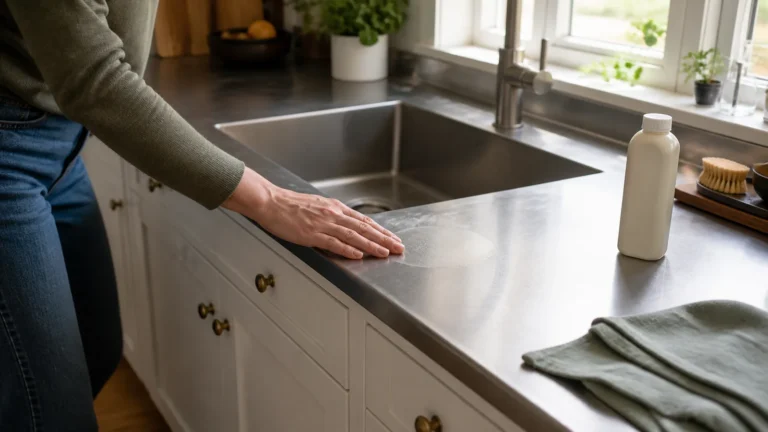
The British Stainless Steel Association notes that rust marks on stainless sinks are often caused by small carbon-steel particles from wire wool or scouring pads becoming attached to the surface. In a damp sink environment, those particles rust and create staining. The same guidance warns that chloride cleaners, hydrochloric acid and concentrated hypochlorite bleach can cause unacceptable staining and pitting.
A mark does not identify the alloy grade
Colour, shine, a magnet and one surface mark cannot verify 304, 316 or another grade. Material identity requires traceable documentation linked to the actual worktop material and, where justified, a suitable test method. Even when grade is confirmed, performance can still be affected by finish, fabrication contamination, weld treatment, cleaning and service environment.
Use the separate guide on why a magnet cannot verify 304 or 316 by itself. A grade investigation and a surface-cause investigation may run in parallel, but they are not the same task.
Record evidence before cleaning
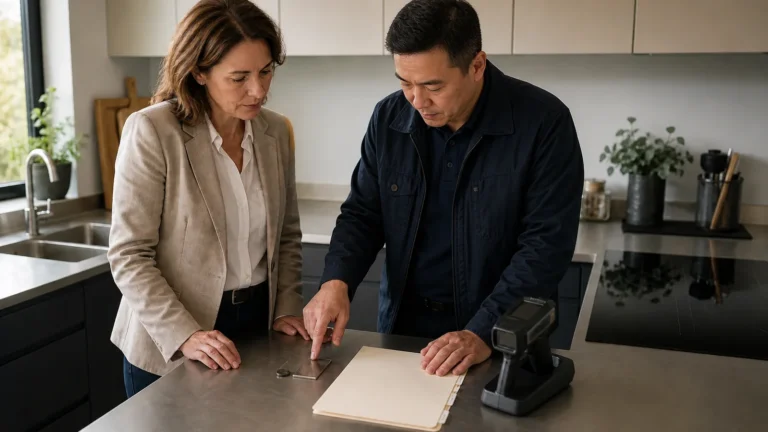
A claim becomes harder to resolve after several unrecorded cleaning attempts. Before touching the mark:
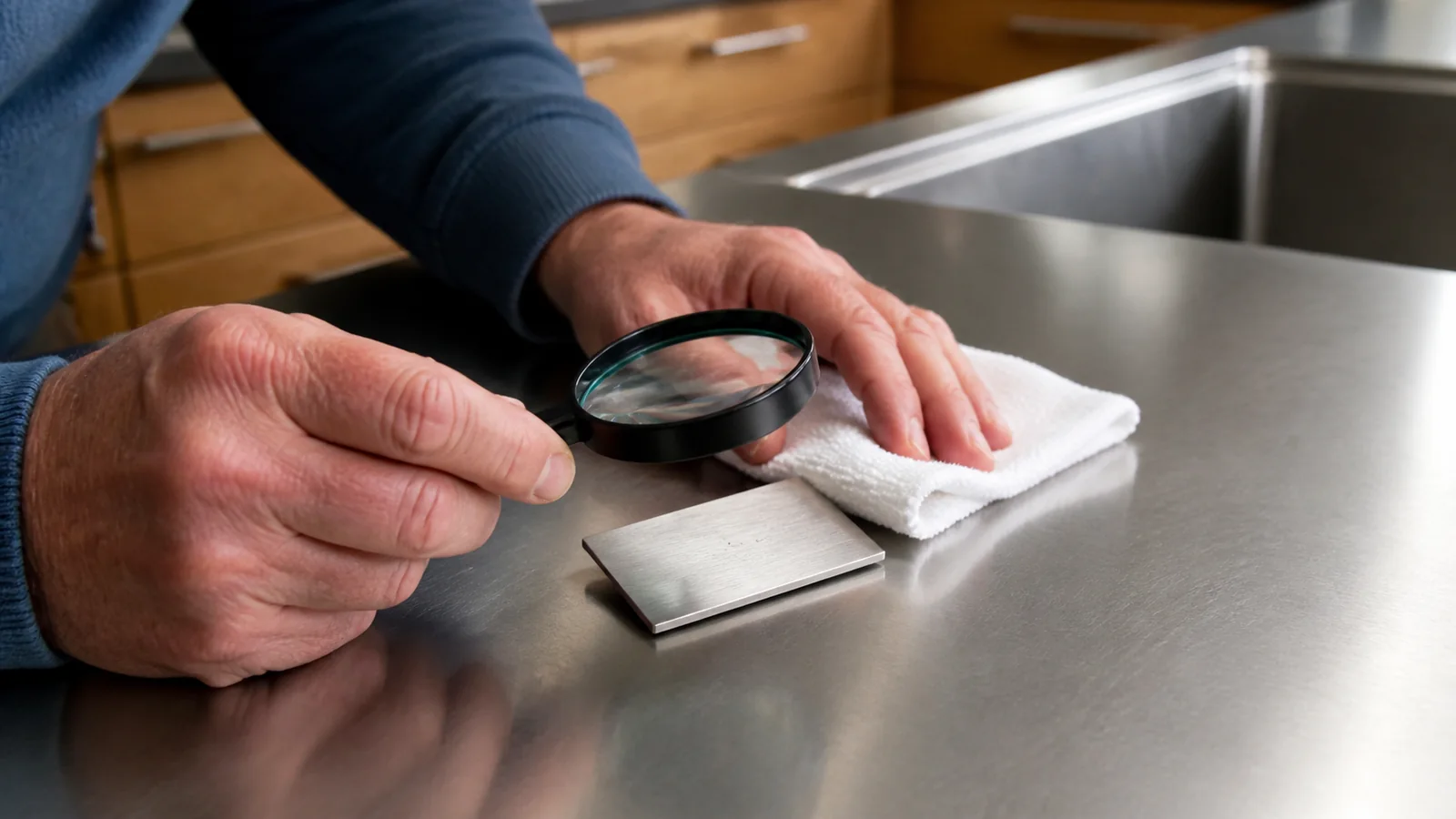
- Photograph the whole worktop, the affected zone and a close view with a scale reference.
- Record the date, cabinet or elevation ID and whether the mark was present before handover.
- List every cleaner, pad, cloth, tool and metal object used nearby.
- Check for standing water, a leaking seal, trapped packaging residue and protective-film adhesive.
- Look for a visible pit, scratch, weld zone or cross-grain repair around the mark.
- Retain any relevant offcut or material coupon instead of testing the finished face first.
worldstainless cleaning and maintenance guidance explains that stainless performs best when clean and that free iron can be introduced by metalworking tools during fabrication. This is why the evidence chain must include both the site and the factory.
Look for conditions that keep deposits wet
A horizontal worktop and sink naturally experience water, salt and food residue. Risk increases where water sits in a corner, a silicone edge has a gap, a wet cloth remains on the surface, a low upstand traps cleaner or the grain and geometry channel residue into a crevice. The correct response is not just stronger polishing; it is removing the retention condition.
ASSDA’s tea-staining guidance identifies environment, grade, finish, contamination, weld condition, drainage and maintenance as interacting factors. It also distinguishes tea staining from other causes such as carbon-steel contamination, uncleaned welds, hydrochloric acid and bleach.
That source focuses strongly on exterior and coastal exposure, so do not transfer its cleaning frequency or grade recommendations automatically to an indoor kitchen. The relevant lesson is diagnostic: brown discolouration has multiple mechanisms, and deposits or crevices that stay wet deserve attention.
Choose corrective action by cause
Start with the fabricator’s approved cleaning method. If a loose foreign stain disappears without changing the grain, monitor the area and remove the contamination source. If particles appear embedded, if the finish changes, or if a pit remains, stop household cleaning and ask a competent stainless specialist to assess the surface.
Do not grind or polish one decorative patch without a finish-matching plan. Directional brushed worktops can show a repaired zone more clearly than the original small mark. Chemical pickling and passivation are specialist processes with significant safety and finish implications; they are not homeowner cleaning instructions.
Assign responsibility from evidence
| Evidence points to | Likely owner of investigation | Required record |
|---|---|---|
| Mark present before unpacking | Supplier, packer and logistics chain | Arrival photographs and package ID |
| Grinding or drilling contamination at site | Installer or adjacent trade | Work sequence, tool separation and cleaning record |
| Unapproved cleaner after handover | Operator or maintenance contractor | Cleaner name, dilution and contact time |
| Ponding at a fabricated sink or worktop | Designer, fabricator and installer jointly until cause is isolated | Level, geometry and water-test results |
| Traceability or grade mismatch | Material supplier and cabinet supplier | Certificates, batch IDs and test method |
Prevent recurrence in fabrication and handover
- Separate stainless work from carbon-steel grinding, filing and wire brushing.
- Use clean dedicated abrasives and tools appropriate to stainless work.
- Protect the visible face during fabrication, packing and installation.
- Remove protective film and adhesive by the approved method at the agreed stage.
- Water-test sinks and inspect wet-zone drainage before handover.
- Give the operator a written list of approved and prohibited cleaners.
- Retain finish samples and material traceability for later comparison.
Surface appearance should be inspected as part of the wider system. Review the quality inspection guide for sample, finish, fabrication and documentation controls. For ordinary mineral residue, use the separate hard-water spot cleaning guide.
Red flags that justify specialist assessment
- The mark has a visible cavity or pit after gentle cleaning.
- Discolouration follows a weld, ground repair or unsealed crevice.
- Marks return quickly after the contamination source is removed.
- Several panels from one batch show the same unexplained condition.
- Chloride, hydrochloric acid or concentrated bleach exposure is known.
- The supplier cannot connect the finished worktop to material records.
- Household cleaning attempts have already changed the local gloss or grain.
Questions to put in the RFQ
- How are stainless parts separated from carbon-steel tools and debris?
- Which weld-cleaning, finishing and contamination-control steps are recorded?
- How does the worktop material remain traceable after cutting?
- Which cleaners and pads are approved or prohibited?
- What arrival and handover photographs are required for a surface claim?
- Who assesses pitting or finish mismatch, and who authorizes specialist repair?
- How will a recurring drainage or crevice condition be corrected?
Bottom line
Rust-coloured spots are a symptom, not a complete diagnosis. Preserve evidence, identify contamination and exposure history, inspect for pits or wet crevices, and use a finish-compatible cleaning method. Material-grade verification may be necessary, but it cannot replace the surface-cause investigation.
Review the project before production
Send your floor plan, destination country and project quantity for a preliminary specification review.