Blog / Systems
Systems · Buyer guide
Will Stainless-Steel Kitchen Cabinets Get Hot Beside an Oven or Cooktop?
The short answer
A stainless-steel cabinet beside an oven or cooktop may become warm, but the material name does not determine whether the installation is acceptable. Use the exact appliance model, manufacturer’s installation instructions, required clearances and ventilation, the full cabinet construction and local installer approval before releasing production.
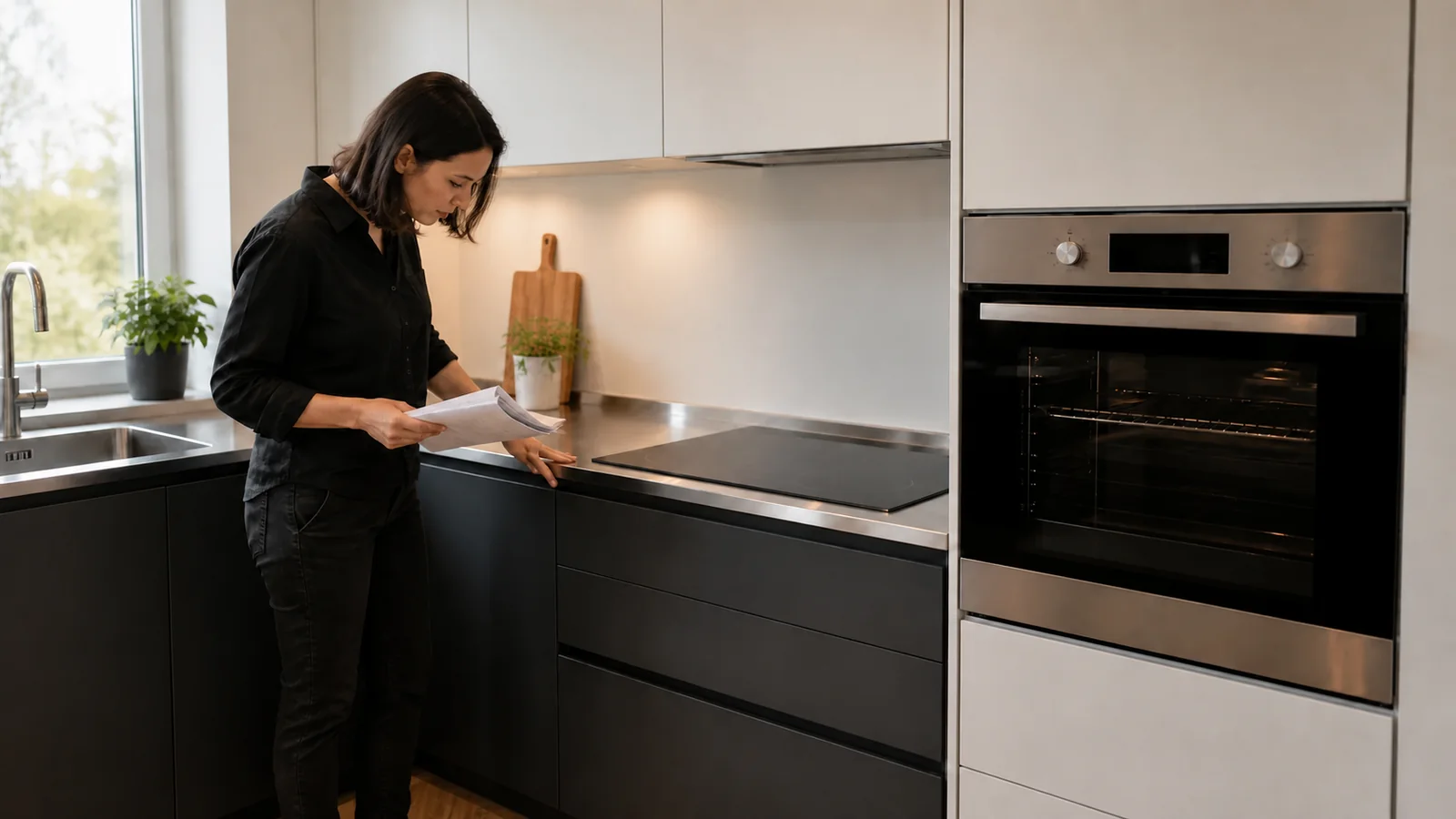
A warm cabinet side does not answer the real question. In many residential systems, the main visible stainless is the continuous worktop, sink and cooktop interface while the adjoining drawer and door fronts are coloured or wood-look. The team still needs to know which appliance is installed, where heat and ventilation air move, what the complete adjoining assembly is made from, and whether the installation follows the model-specific instructions. Neither the phrase “stainless-steel kitchen” nor the worktop material replaces that review.
Warm is not a complete diagnosis
Cooking appliances generate and manage heat in different ways. Some discharge cooling air at the front, some require air below a cooktop, and some impose clearances to combustible surfaces or limits on cabinet geometry. A surface that feels warm may still be within the appliance design, or it may signal blocked ventilation, wrong installation dimensions or abnormal operation. Touch alone cannot distinguish those cases.
Check the appliance manual and commissioning conditions. If there is discoloration, delamination, softened seals, deformation, a burning or electrical odour, smoke, repeated shutdown or unusually increasing heat, stop treating the issue as a cabinet-material question and obtain qualified appliance and installation assessment.
The appliance model is a production input
Do not freeze cabinet drawings from a generic “600 mm oven” or “36-inch range” description. Record the manufacturer, exact model, regional version and current installation document revision. Wolf states that its products should be designed to the dimensions in the Wolf Design Guide and does not approve alternate dimensions outside those specifications.
Different models in the same nominal width can have different body depth, door projection, control location, service connections, ventilation path and required surrounding space. A late appliance substitution therefore reopens the cabinet interface.
Review the complete cabinet construction
A cabinet described as stainless steel may still contain backing, adhesive, a core, seals, hardware, coatings, edge components or adjacent decorative panels. The worktop, wall lining and filler may use other materials. The responsible team must review the complete material stack-up rather than assuming the whole assembly has the behaviour of bare stainless sheet.
Whirlpool’s model instructions tell installers to use the stated clearances and warn that cabinet materials can discolour, delaminate or sustain other damage if they are not suitable for the appliance conditions. Wolf likewise notes that heat from some range installations may affect adjoining side-panel material. These are manufacturer-specific warnings, not proof that every appliance will damage cabinetry.
Ventilation is part of the cabinet interface
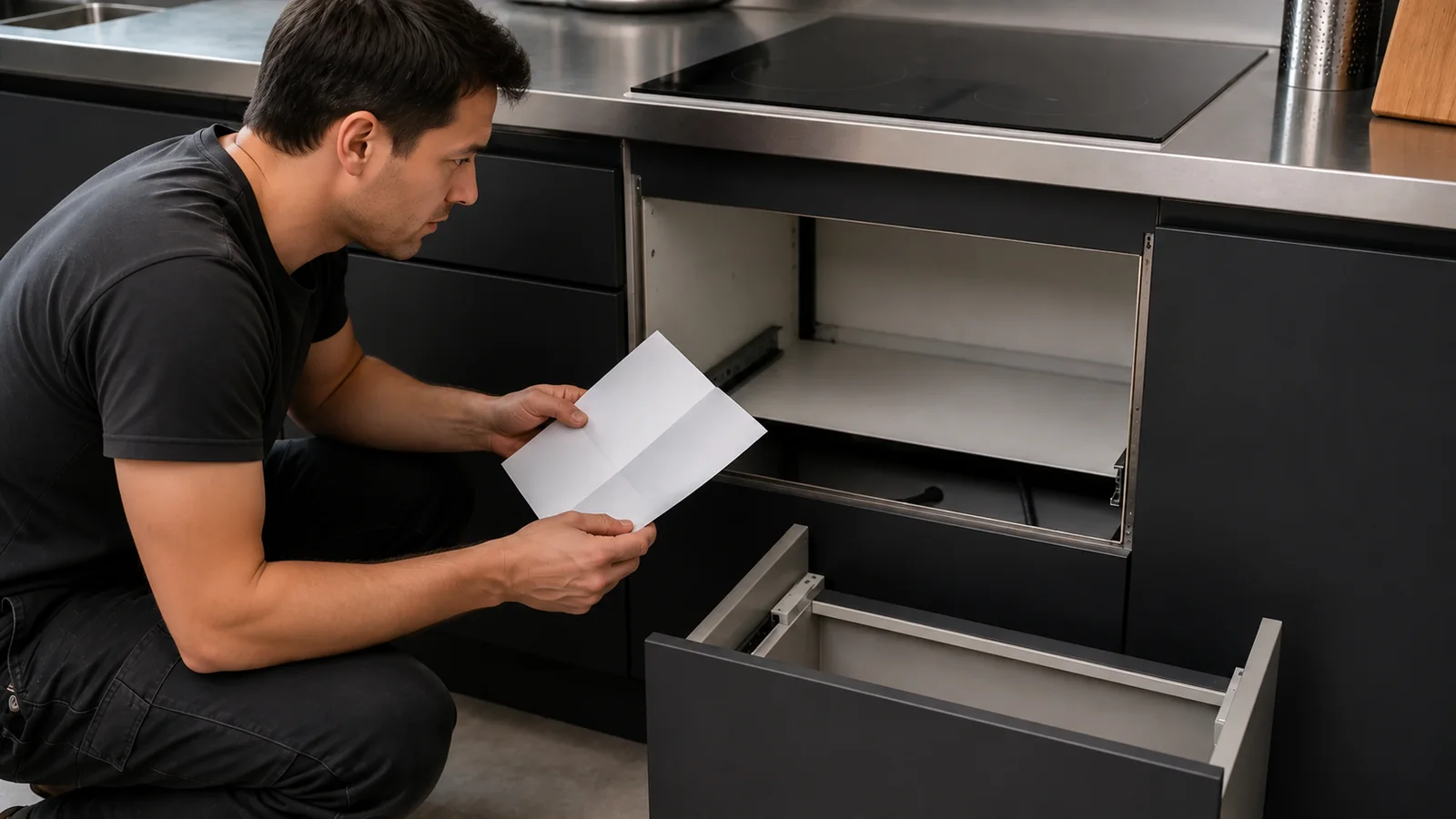
Ventilation openings are functional, not leftover space. A Bosch induction-hob installation guide illustrates required rear, lower and inter-appliance airflow paths for that model family. Blocking a vent with a drawer back, liner, service panel or stored item can invalidate the intended installation.
- Transfer every required opening and clearance from the exact manual into the cabinet drawing.
- Show the path of incoming and outgoing cooling air, not only the cut-out.
- Check whether drawers or organizers can enter the ventilation zone.
- Coordinate the worktop fabricator, cabinet supplier and appliance installer.
- Keep access to electrical, gas and service points where the manual requires it.
Use a model-first drawing-release gate
- Freeze the exact appliance model and destination-market version.
- Obtain the current manufacturer installation instructions and local requirements.
- Extract the cut-out, support, clearances, ventilation, power or gas, door movement and service-access requirements.
- Overlay those requirements on the cabinet and worktop drawings.
- Review every adjacent material, including hidden cores, fillers, seals and wall finishes.
- Resolve conflicts in writing with the appliance manufacturer or responsible local installer.
- Mark the appliance model and manual revision on the approved cabinet drawing.
- Reopen approval if the appliance model changes before installation.
This release gate complements the broader guide to preventing custom cabinets from failing to fit on site.
Do not invent a universal clearance
A number copied from another appliance, another country or an online discussion is not a safe project rule. Clearances can vary with fuel type, model, overhead conditions, adjacent materials, ventilation configuration and local regulation. Where the manual and local requirement differ, the responsible local professional must determine the controlling condition.
The cabinet supplier should not reduce a manufacturer clearance because the visible panel is stainless steel. Nor should the supplier add a generic gap that interferes with appliance support, door geometry or ventilation. Every dimension needs a source and an owner.
Do not invent a heat shield
A metal sheet added beside an appliance is not automatically an approved heat shield. Its material, thickness, air gap, fixing, edge condition and relationship to the appliance instructions all matter. It may trap heat or block ventilation if improvised.
Use only a shield, backguard or insulation arrangement permitted by the appliance manufacturer and accepted by the responsible installer or authority. Record it on the drawing and BOM.
Check door projection and user contact
Heat coordination is not limited to the closed appliance body. Oven doors, range fronts, handles and hot cookware can project beyond the cabinet line. Review the open-door position, adjacent drawer and door swings, corner traffic and handle reach. A technically compliant cut-out can still create a poor or unsafe user interface if moving parts collide or direct users into hot zones.
Commission the installed interface
- Confirm the installed model matches the approved drawing.
- Verify all required vents and clearances remain open after worktop and trim installation.
- Check that the appliance is level, supported and connected by the appropriate qualified trades.
- Operate it through the manufacturer-prescribed commissioning process.
- Observe adjacent materials for abnormal odour, colour change, deformation or blocked airflow.
- Photograph the final interface and keep the appliance manual with the handover record.
Do not use an infrared reading or a hand-touch check as a pass/fail rule unless the appliance manufacturer or project specification provides the method, location and limit.
Responsibility should be explicit
| Party | Typical responsibility to define |
|---|---|
| Designer or project lead | Freeze model, coordinate space and approve the interface |
| Cabinet supplier | Build to approved drawings and disclose the adjoining material construction |
| Worktop fabricator | Cut and support the appliance opening to the approved detail |
| Local appliance installer | Install and commission to the model instructions and local requirements |
| Gas or electrical trade | Complete regulated connections within the local scope |
Anray’s public project process assigns final measurement, installation and site adjustments to named local owners rather than implying local turnkey installation. The local project team must own final site verification, regulated connections and installation sign-off; Anray can coordinate the agreed cabinet drawings, production, inspection and handover information.
Questions to put in the RFQ
- Which exact appliance models and regional versions are approved?
- Which manual revision controls each cut-out, clearance and vent?
- What is the complete construction of adjacent cabinet panels and fillers?
- Are any shields, backguards or insulation components manufacturer-approved?
- Can drawers, organizers or stored items obstruct ventilation?
- Who signs off the local installation and commissioning?
- What happens if the appliance model changes after cabinet approval?
Bottom line
Stainless-steel cabinets can become warm beside an oven or cooktop, but acceptable installation cannot be decided from the metal name. Freeze the exact appliance, follow its current instructions, review the entire cabinet assembly, preserve ventilation and require local installer sign-off before production and commissioning.
Review the project before production
Send your floor plan, destination country and project quantity for a preliminary specification review.