Blog / Materials
Materials · Buyer guide
Do Stainless-Steel Kitchen Cabinets Scratch, Dent or Show Fingerprints?
The short answer
Yes. Stainless-steel kitchen cabinets can scratch, dent and show fingerprints. The practical question is how visible those marks will be and how easily the surface can be maintained. Finish direction, panel construction, reinforcement, handling, cleaning method and sample approval all affect the result.
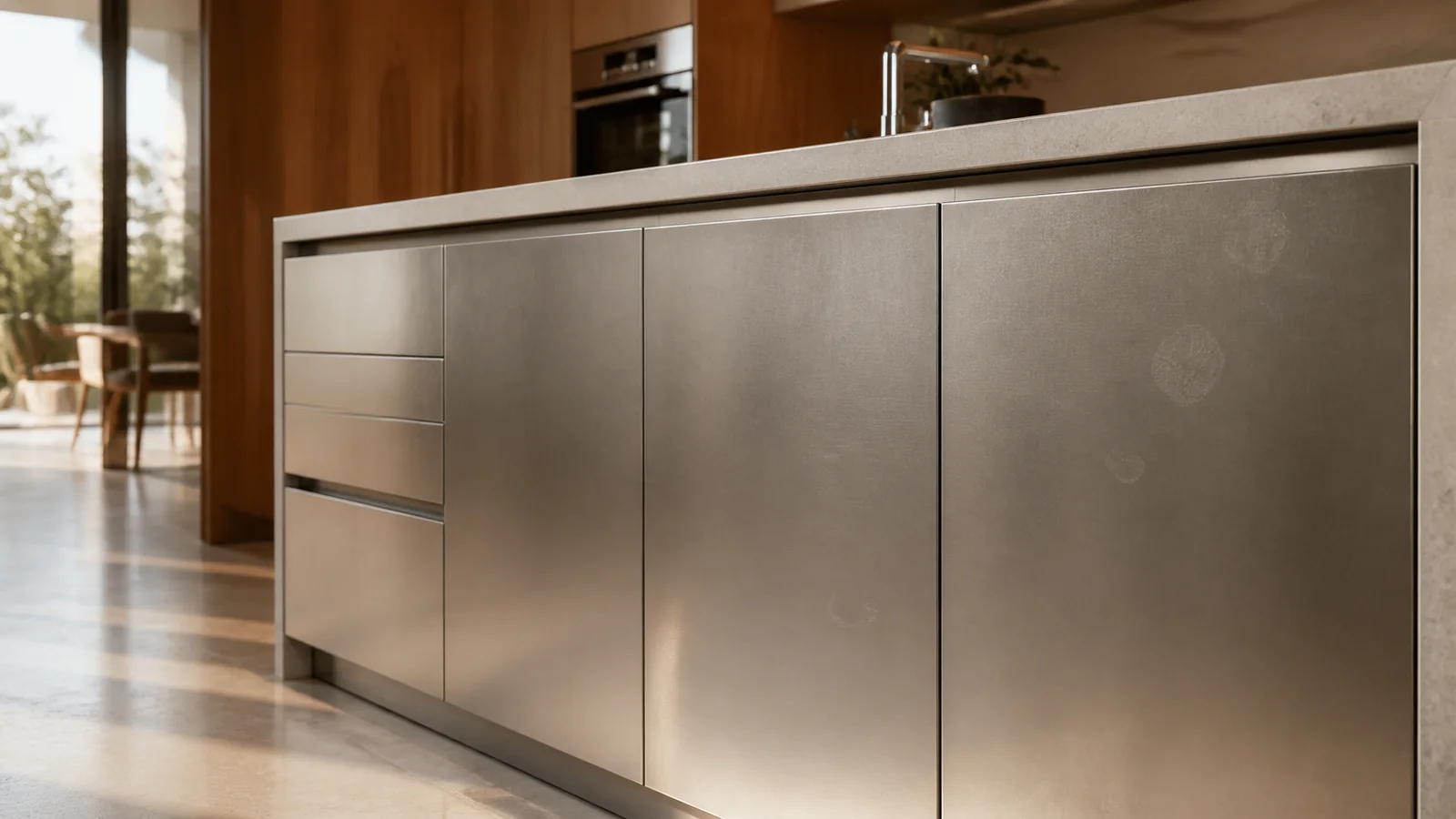
Buyers often hear two extreme claims: stainless steel is either indestructible or impossible to keep presentable. Neither is useful. It is a durable architectural material, but it is not immune to impact, abrasion or skin oils. A good specification makes those behaviours manageable and visible expectations explicit before production.
Will stainless-steel kitchen cabinets scratch?
They can. A brushed surface may pick up marks from abrasive pads, dragging metal objects, construction debris or wiping across the finish with trapped grit. The Australian Stainless Steel Development Association advises cleaning in the direction of the polishing grain and warns against steel wool and other aggressive methods. See its indoor stainless-steel cleaning guidance.
Scratch visibility depends on the finish, viewing angle, lighting and the direction of the mark. A random scratch crossing a linear grain is usually more obvious than a light mark running with it. That is why a finish name alone is not enough. Ask for a physical sample made with the proposed material and finish direction, then inspect it under lighting similar to the room.
What to approve before ordering
- Finish reference and grain direction on doors, drawer fronts, end panels and fillers.
- A physical sample, not only a screen image or finish code.
- Protective-film rules for production, packing and installation.
- Cleaning instructions for handover to the homeowner or facility team.
- The supplier’s repair position for light cosmetic marks; do not assume every scratch can be invisibly refinished on site.
Can the cabinet fronts dent?
Any formed metal panel can deform if the impact is large enough. Dent resistance cannot be judged from the words “stainless steel” alone. It depends on sheet thickness, folded geometry, return edges, backing or reinforcement, panel size, attachment method and where the impact occurs.
For a project comparison, ask suppliers to describe the door and panel construction in the same level of detail. A thicker sheet is not automatically a complete answer: a well-engineered folded panel and a flat unsupported panel behave differently. If impact resistance is a serious concern, request a representative sample or mock-up and agree how it will be evaluated. Avoid accepting an unsupported “dent-proof” claim.
Do stainless-steel cabinets show fingerprints?
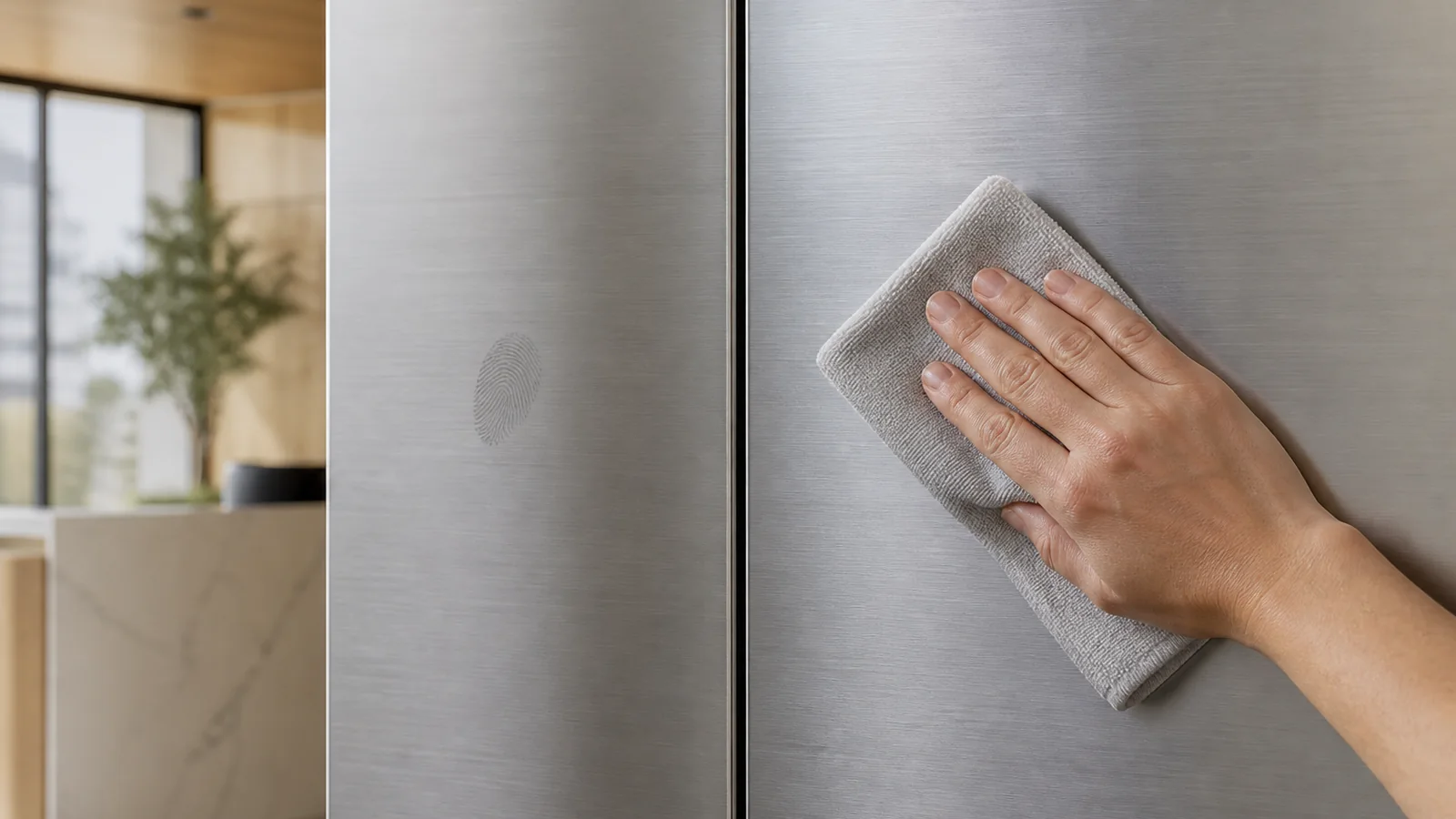
Yes, especially on frequently touched areas and under side lighting. Fingerprint visibility varies with the finish and the amount of contrast created by the room lighting. Handles, edge pulls and touch-to-open layouts also change how often users contact the face.
World Stainless notes that fingerprints on stainless steel can generally be removed with soapy water or a damp microfibre cloth and that abrasive products should be avoided. Its cleaning guidance for stainless steel in the home also recommends wiping with the grain on directional finishes.
Some mills offer specialized surfaces intended to reduce the visibility of fingerprints or stains. That proves such technology exists; it does not prove that a specific cabinet quotation includes it. Ask for the exact product, sample, care instructions and replacement matching policy. “Fingerprint-resistant” should never be interpreted as “fingerprint-proof.”
A practical cleaning routine
- Remove loose grit before wiping.
- Use warm water with a mild detergent for routine soil.
- Use a clean, soft microfibre cloth.
- Wipe in the direction of the brushed grain.
- Rinse away cleaner residue where required, then dry with a clean cloth to reduce water marks.
- Do not use steel wool, harsh abrasive powder or an unapproved chemical.
Always follow the cabinet supplier’s care instructions because coatings, dark finishes and decorative treatments may have different restrictions from bare brushed stainless steel.
How to reduce visible wear in the design
| Concern | Useful design response | What to verify |
|---|---|---|
| Fingerprints around touch points | Use handles or edge pulls that reduce contact with the face | Handle projection, ergonomics and cleanability |
| Marks visible in grazing light | Review finish samples under planned lighting | Grain direction and batch consistency |
| Impact at high-traffic corners | Detail protected edges and appropriate panel construction | Returns, reinforcement and replaceability |
| Construction-stage damage | Keep protective film until the agreed installation stage | Who removes film and records defects |
Questions to put in the RFQ
- What is the visible finish reference, and can you provide a physical sample?
- How are large door and end panels formed and reinforced?
- Which surfaces are supplied with protective film?
- What cleaning products are permitted and prohibited?
- Is any anti-fingerprint treatment included? If yes, identify the exact surface and care requirements.
- How are cosmetic defects defined at pre-shipment inspection and at site receipt?
These questions turn a vague material preference into a reviewable specification. For grade selection in different exposure zones, read 304 or 316 stainless steel for kitchen projects. For a broader commercial comparison, use the custom kitchen quotation checklist.
Bottom line
Stainless-steel cabinets are not maintenance-free or damage-proof. They can still be a practical residential choice when the project controls finish selection, panel construction, handling, sample approval and cleaning. The right buyer question is not “Will it ever mark?” but “What will the approved surface look like in use, and how will the team protect and maintain it?”
Review the project before production
Send your floor plan, destination country and project quantity for a preliminary specification review.