Blog / Systems
Systems · Buyer guide
Tall Pantry Pull-Out or Internal Drawers for a Stainless-Steel Kitchen?
The short answer
Choose between a pantry frame that moves together and internal drawers that open separately behind a door. Compare them with your usual groceries, the available cabinet space and the opening sequence. Stainless cabinet construction does not determine access, operating effort or load capacity; those depend on the specified hardware and complete assembly.
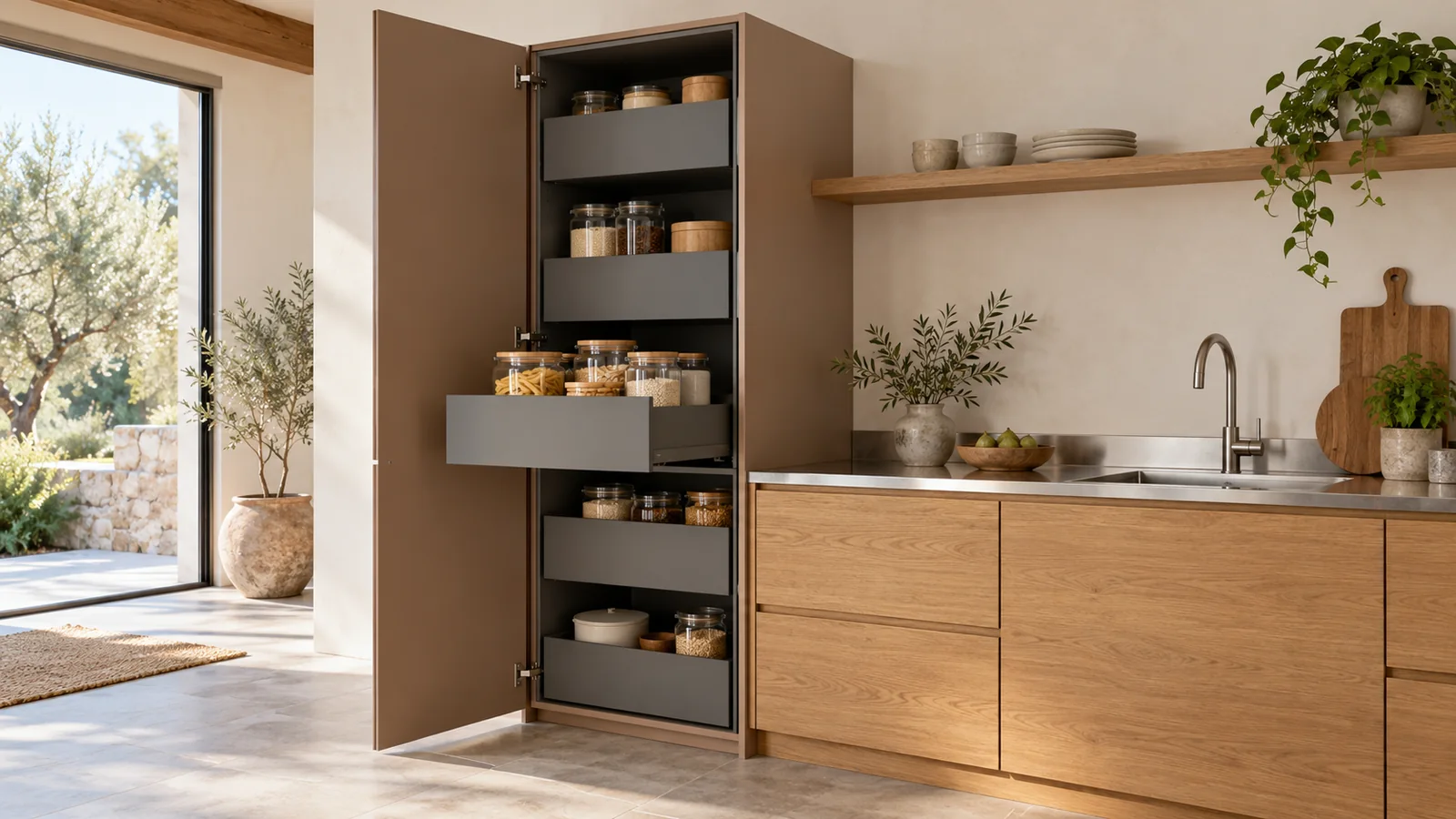
Try a tall pantry with the groceries you expect to keep in it. Find a jar at the back and lift out the largest bag you normally buy. Then work through putting a shop away. That gives you a better basis for choosing the storage format than an empty display.
A cabinetry discussion comparing tall pull-outs with individual shelves raises questions about loaded operation and long-term service. The comments describe mixed experiences. They are useful questions for a showroom or supplier review, but they do not provide a controlled durability ranking.
Start by asking what moves
In a whole-frame pantry pull-out, the storage tiers move out as an assembly with the front. This gives you a way to bring the stored groceries forward in one opening movement. Kesseboehmer’s DISPENSA is a manufacturer example with adjustable tiers and access from both sides.
With internal drawers, you open the cabinet door and then the drawer you need. Blum’s SPACE TOWER planning information, page 2, describes individually opening pull-outs with access from the front and sides. It is one example of this format.
Neither named system should be assumed to be standard equipment in an Anray kitchen. Use the examples to identify the arrangement you want, then request the exact hardware and cabinet detail offered for your project.

Compare the opening sequence in your room
| Decision | Whole-frame pull-out | Internal drawers behind a door |
|---|---|---|
| Getting one item | The storage assembly moves forward | Open the door, then the selected drawer |
| Looking through groceries | Compare visibility along the opened tiers | Compare the view into each opened drawer |
| Space around the cabinet | Check room for the extended assembly and the person using it | Check the hinged door and drawer extension together |
| Changing the arrangement | Check the actual tier-adjustment options | Check the actual drawer and upper-shelf configuration |
These are comparison prompts. The most suitable format depends on the proposed unit and its position. A pantry against a wall needs a different opening review from one with clear space on both sides.
Draw the nearby fridge, worktop and other cabinet fronts in their open positions. Mark where someone stands to retrieve groceries. If the design relies on opening a hinged door farther than the room allows, revise the door, filler or storage arrangement before confirming the cabinet width. The cabinet filler guide explains why those small spaces deserve early attention.
Use your groceries as the test contents
Measure the items that are hardest to accommodate in your current pantry. These might be a tall bottle, a wide cereal box or a bulk bag. Add the small jars that tend to disappear at the back, and note which items you use every day.
Ask to try the proposed format with representative contents, within the manufacturer’s permitted loading. Check opening and closing, reaching the rear, lifting a container clear and returning it without moving several unrelated items. Include the household members who will use the pantry most often.
For an illustrative comparison, a household storing mostly small jars might value a clear view into individual drawers. Another might prefer viewing several narrow tiers together. Those preferences should be tested in the available space; they do not establish a universal winner.
Pay particular attention to the upper area. A tall cabinet does not make every storage level equally useful to every person. Put frequent-use items where the intended users can reach and lift them comfortably, and review the role of less accessible storage separately.
Ask what a load rating actually covers
A quotation should identify the hardware model and the applicable installation document. Ask whether a quoted rating applies to an individual tray, a runner, a complete moving assembly or a tested cabinet configuration. Also ask whether the stated load includes the moving components themselves.
Have the cabinet supplier confirm how the specified fittings attach to the proposed body and front. This matters for a stainless cabinet just as it does for any custom assembly. The cabinet material name cannot establish the rating of unspecified runners or their connections.
Compare quotations using matching definitions. Do not put a per-drawer figure beside a whole-pantry figure and call the larger number stronger. The drawer load-rating guide covers that distinction in more detail.
Ask for adjustment, removal and replacement information as well. A useful service question is who can identify and obtain the specified part in the destination market. Avoid accepting a predicted lifespan without evidence for the actual system and conditions.
Integrate the pantry into the residential stainless kitchen
The pantry front can continue the kitchen’s timber-look, white or coloured finish. Its internal storage format can be chosen separately, provided the front, hinges or brackets and cabinet body are coordinated. This allows a domestic appearance alongside a deliberately specified steel cabinet system.
Put the body construction, front, hardware, usable dimensions, opening requirements and intended contents on one schedule. Ask each supplier to quote against it and explain any substitutions. If the storage format changes, repeat the grocery and opening checks before accepting the revised proposal.
For Anray supply, confirm the selected hardware and construction within the project scope. You appoint the local team for measurement and installation. A trial assembly, where agreed, can be used to review the selected cabinet configuration; it is not evidence of a universal pantry load or lifetime rating.
Compare pantry options on your layout
Send the pantry location and your preferred storage arrangement, along with the important grocery dimensions, door style and any hardware already selected. Include the destination and local installation plan for a coordinated cabinet review.