Blog / Project Process
Project Process · Buyer guide
Can You Replace Only a Sink Base Cabinet with Stainless Steel?
The short answer
You may be able to replace a sink base with stainless steel while retaining the surrounding kitchen. First have the local installer assess the existing cabinet connections, worktop and sink support, plumbing, and removal route. Keeping the worktop does not necessarily mean it can stay in place throughout the work.

If the cabinet below your sink needs replacing, start with a survey of that unit and the parts connected to it. A stainless-steel replacement may let you keep the rest of a kitchen you like. Find out what can be retained and matched before choosing between a single module and a larger refit.
That concern appears in a homeowner discussion about replacing one failing base cabinet: the owner wants to keep both the other cabinets and the countertop. A forum cannot establish whether your kitchen allows the same approach. It does identify the decision your survey needs to resolve.
Define exactly what you want to keep
“Replace the sink cabinet” can describe several different jobs. You might retain the sink and worktop, keep the visible doors but replace the body, or replace the complete sink station including its surface. Write down which of those outcomes you want before requesting a price.
| Part | Record before ordering | Question for the local team |
|---|---|---|
| Worktop and sink | Material, joints, fixing points and underside photographs | How are they supported now, and during replacement? |
| Cabinet body | Actual dimensions, connections and condition | Can the existing unit be separated from its neighbours? |
| Doors and handles | Dimensions, hinge positions, edge details and finish | Can they be retained or accurately matched? |
| Services and floor | Pipe positions, valves and changes in floor level | What constrains the removal and installation route? |
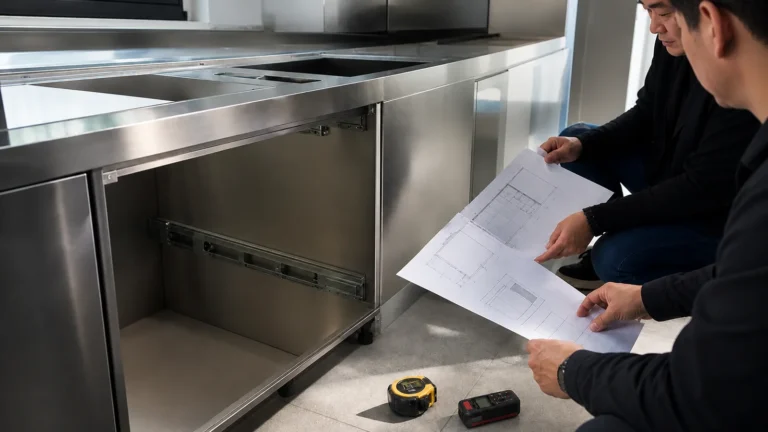
Treat this as a survey worksheet. Photographs help a supplier understand the request; they do not replace inspection of concealed connections. If the cause of the original damage is unresolved, include investigation and repair of that cause in the local scope.
Retaining the countertop needs its own plan
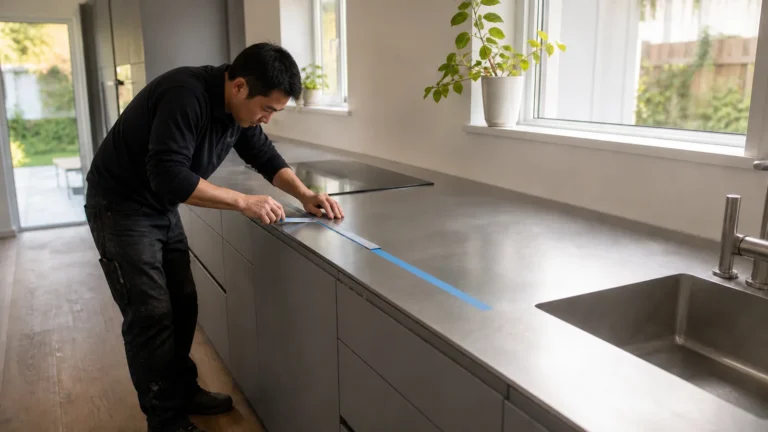
Ask the installer to distinguish “reuse after removal” from “leave in position.” Those are different proposals. For the second, request an explanation of how the top and sink remain supported while the old cabinet is taken out. For the first, ask the worktop specialist to assess removal, handling and reinstallation before assuming reuse is practical.
Do not order a replacement cabinet from the visible opening alone. Record the underside of the top, any supporting rails, adjacent connections, the front line and the finished floor. The drawing should show the new support arrangement, with responsibility agreed between the cabinet supplier and the local installer.
If you also want a different sink, decide that early. BLANCO’s buying guide identifies the existing cutout and cabinet space as constraints on replacement choice. A larger bowl can therefore turn a limited cabinet replacement into a wider worktop project. Confirm the actual sink specification rather than selecting it from a nominal cabinet width.
What stainless steel adds to a wet-zone replacement
A stainless body gives you a way to specify the material around the sink separately from the rest of the kitchen. Its corrosion resistance is a relevant reason to consider it here: the British Stainless Steel Association discusses domestic sinks and work surfaces as examples of stainless use in normal water-based environments, while distinguishing more aggressive conditions.
Have the quotation identify the stainless components and any different cores or finishes. Ask for the base, corner and service-opening details so you can compare the replacement with your existing cabinet. Check whether the price covers a stainless body or a lining fitted to another construction.
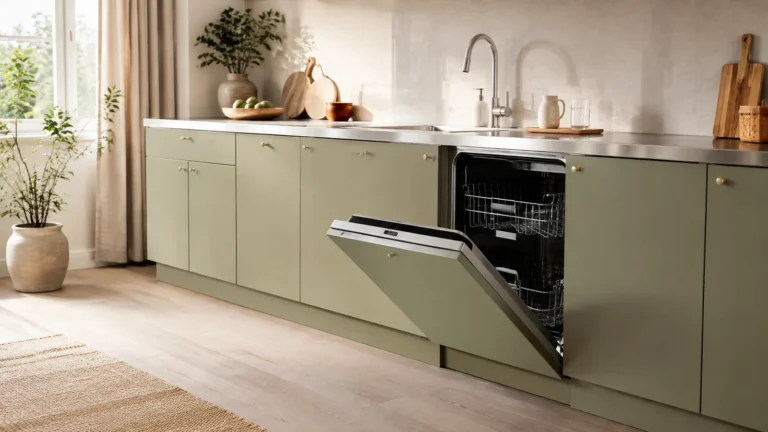
The appearance can stay domestic. Retained fronts, matching painted doors or a deliberate accent finish may suit the surrounding kitchen. Reusing doors requires a fit and hinge review; a similar face width alone is insufficient. If material names in quotations are unclear, use the guide to cabinet bodies, cores and fronts.
Choose the smallest scope that solves the actual problem
Use the survey to decide how far the work needs to go. If the issue is limited and the support remains sound, ask whether a local repair will solve it. If the surrounding kitchen can stay, price the replacement sink module. Where the survey identifies connected work, compare a longer replacement run before paying for separate jobs that repeat it.
Compare complete proposals. Include local removal, temporary arrangements, plumbing reconnection, worktop work and finish matching as applicable. A lower cabinet-only price does not establish a lower installed project cost. No fixed saving can be calculated without those items and a verified site scope.
For example, an owner might hope to keep a stone top and its existing sink while changing only the box underneath. If the local assessment requires the top to be lifted, the owner can decide whether reuse still makes sense before a custom box is manufactured. This is an illustrative decision sequence, not an Anray customer case.

Prepare a replacement enquiry that can be assessed
- Mark the proposed replacement unit on the full kitchen plan.
- Photograph the whole run, the open cabinet, the sink underside and adjoining units.
- List retained, replaced and unresolved items separately.
- Attach the local installer’s survey and proposed worktop-support approach.
- Identify who will disconnect and reconnect services, and who will confirm final dimensions.
Anray’s residential system work is reviewed against the project scope. A one-cabinet replacement is not automatically a suitable export order; confirm supply suitability and the local work involved before proceeding. Customers appoint their own local measurement and installation team. The project process explains that handover.
If your intention is the reverse, keeping the cabinets and changing the worktop, read fitting a stainless worktop to existing cabinets. It involves a different retained-and-replaced scope.
Review the replacement scope
Send your marked-up plan and cabinet photographs, together with the destination and your local installer’s findings. Anray can assess whether the proposed replacement belongs within a suitable supply scope before a manufacturing specification is agreed.