Blog / Systems
Systems · Buyer guide
Can an Integrated Stainless-Steel Sink Cause Condensation Inside the Cabinet?
The short answer
Yes. If the sink underside becomes colder than the surrounding humid air’s dew point, moisture can condense on it. But under-sink water may also come from plumbing, faucet penetrations, sealant, a dishwasher or spills. Dry the area, test each source separately and correct the moisture source before treating odor, mold or cabinet damage.
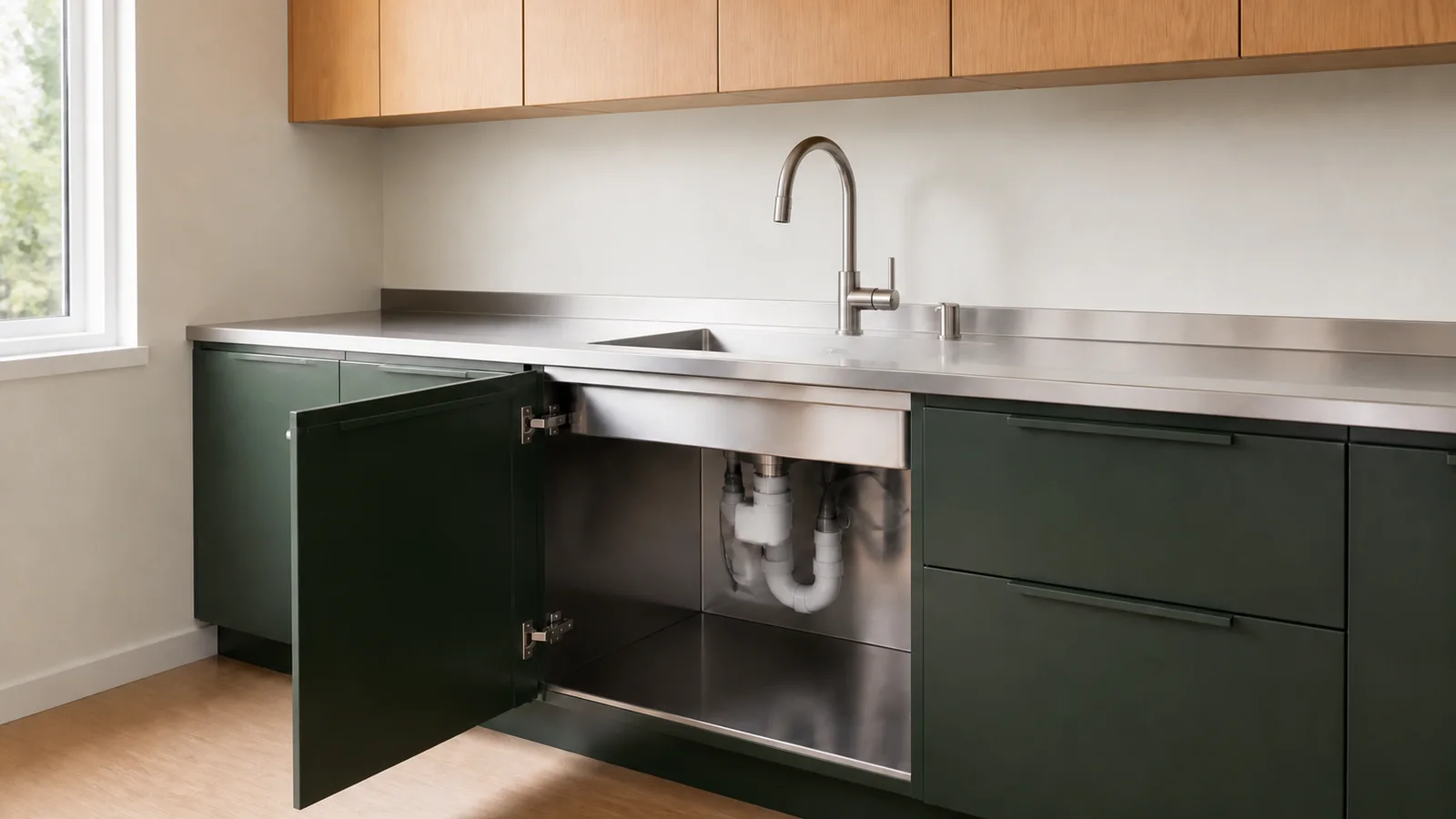
A stainless inner cabinet is easier to wipe and does not swell like an unprotected wood-based panel, but it does not cancel condensation, plumbing leaks or moisture on adjacent walls and stored items. The correct question is not “Can stainless get wet?” It is “Where did the water come from, how long did it remain, and which parts of the assembly are affected?”
Why condensation forms
Condensation occurs when humid air reaches a surface cold enough for water vapour to become liquid. A sink holding ice, very cold water or chilled food can cool its underside below the surrounding air’s dew point. In a humid, poorly ventilated cabinet, droplets may form even when every plumbing joint is sound.
The US EPA moisture and mold guide explains that condensation can form on cold surfaces and recommends reducing humidity, increasing ventilation or air movement, insulating cold surfaces where appropriate and drying wet areas promptly. That building-science principle applies to the under-sink zone; it does not prove that every droplet is condensation.
Use a controlled diagnostic sequence
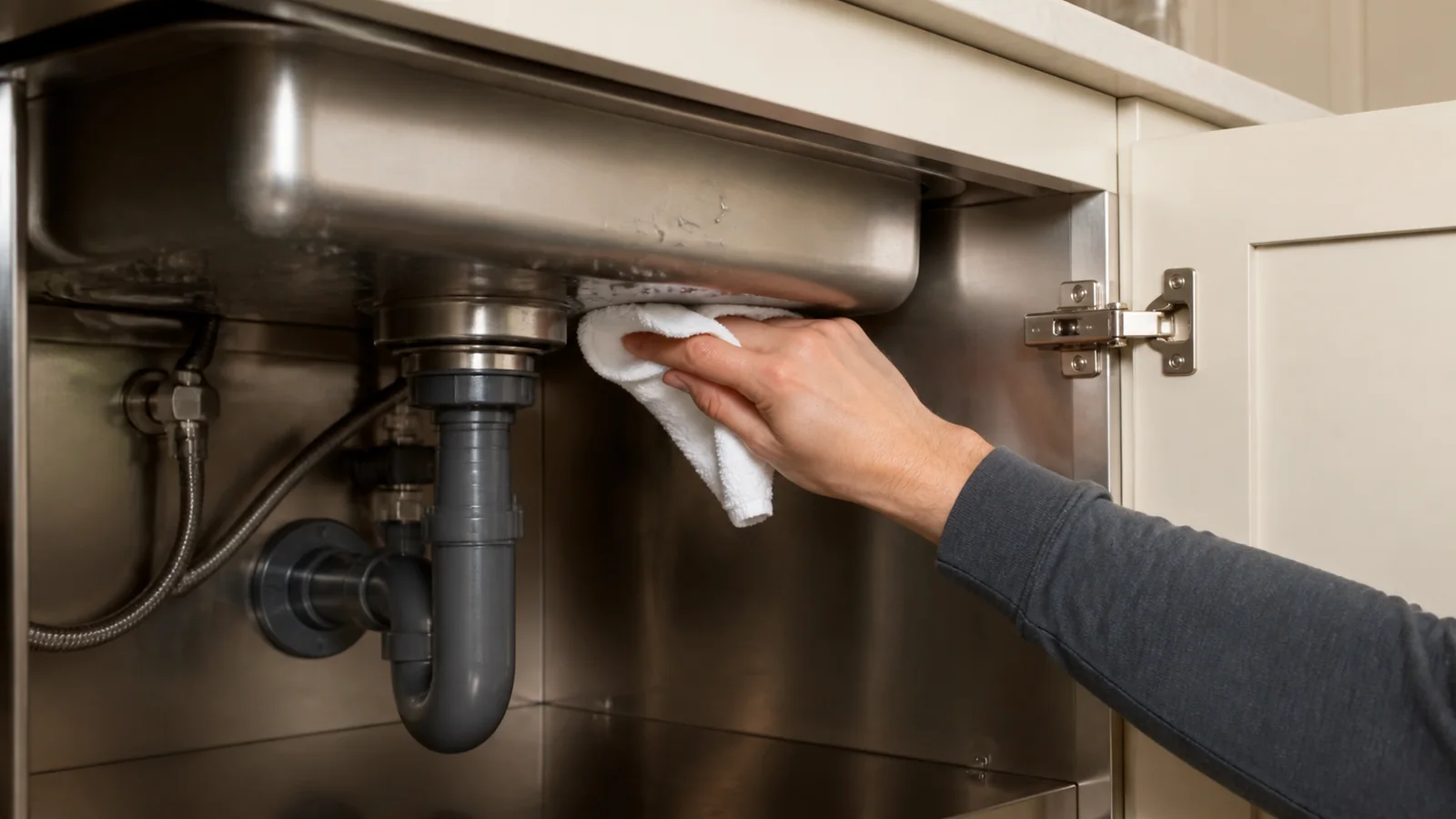
- Empty and dry the cabinet. Remove stored products and wipe every surface so new moisture can be located.
- Inspect supply and waste connections. Use dry tissue around each joint while running hot and cold water separately.
- Check faucet and accessory penetrations. Splash water around the deck only after plumbing joints have been observed.
- Check the sink-to-worktop and upstand interfaces. A failed seal may leak only during wiping or heavy splashing.
- Run the dishwasher or disposal separately. Intermittent appliance discharge can be mistaken for condensation.
- Test the cold-load condition. Only after leak sources are cleared, use the agreed cold-water or ice condition and monitor the sink underside.
- Record humidity, time and location. Condensation should correlate with the cold surface rather than a single fitting.
The EPA’s interactive mold house specifically identifies leaking pipes under a kitchen sink as a potential cause of mold in cabinets and walls and recommends qualified repair. A diagnosis must therefore test plumbing before assuming that the metal surface is simply “sweating.”
Condensation and leaks leave different clues
| Observation | More consistent with | Next check |
|---|---|---|
| Fine droplets spread across the cold bowl underside after ice use | Condensation | Humidity, cabinet airflow and underside insulation |
| Localized wetness at a supply fitting while water runs | Pressurized plumbing leak | Valve, hose, connector and installer test |
| Water appears only while the sink drains | Waste or overflow connection | Trap, strainer, disposal and overflow assembly |
| Wet line below the faucet or soap-dispenser hole | Deck penetration or splash entry | Seal, fixing and faucet-body path |
| Moisture after dishwasher discharge | Appliance hose or connection | Dedicated appliance cycle test |
| Musty wall or floor with no current droplet | Previous or hidden moisture | Moisture meter and qualified inspection |
Do not treat stainless as a moisture guarantee
Stainless steel is non-porous and cleanable, but mold can grow on dust, food residue, sealant, stored paper, wall finishes and other organic material if moisture persists. Water can also travel through service penetrations to the wall, plinth, floor or adjacent cabinet. A dry-looking steel base does not prove that every concealed layer is dry.
If visible mold or significant water damage is present, follow local health and remediation guidance. Do not seal a wet cavity or cover an odor with fragrance. Fix the source, dry the assembly and assess porous materials that may need removal.
Specify the underside deliberately
Some residential stainless sinks use pads and an insulating undercoating. Kraus, for example, describes anti-condensation undercoating on its undermount sink range. This is a product-specific feature and performance statement, not evidence that every pad or coating eliminates condensation in every climate and use condition.
For a custom integrated sink, ask the supplier to state whether the underside is bare, padded, coated, insulated or enclosed; which areas are covered; how the material behaves around welds and drain fittings; and whether it remains accessible for inspection. Do not add an unknown spray product after installation without checking adhesion, fire, odor, hygiene and service implications.
Do not confuse sound pads with a verified condensation solution
A pad intended to reduce vibration may provide some thermal separation, but the project should not assume that acoustic treatment equals full anti-condensation insulation. The earlier guide on stainless-cabinet and sink noise explains that sound paths and damping need system-level review. Condensation needs its own environmental and thermal assessment.
Design for inspection and drying
- Keep valves, traps, strainers and appliance connections visible and reachable.
- Avoid a decorative closure that requires damaging the cabinet to reach a leak.
- Provide a removable service panel where the wall connection is concealed.
- Seal service penetrations according to the project detail without blocking necessary access.
- Keep vulnerable stored items off the cabinet floor or use a removable tray that does not hide leaks.
- Consider a leak sensor where project risk and maintenance capability justify it.
- Define cabinet ventilation only after considering pests, odor, fire and adjacent-room conditions.
Control the source, not only the symptom
If humid room air is the main driver, improve kitchen extraction, air movement and humidity control. If an uninsulated cold-water pipe is sweating, treat the pipe with an appropriate plumbing solution. If the sink is repeatedly used as an ice bath, the operator needs to understand the design condition and inspect the cabinet afterward. If water comes from a failed seal or fitting, repair that source rather than adding more absorbent material below it.
Persistent water in the bowl can increase wet-zone exposure but is a separate geometry issue. Use the integrated sink drainage guide to define the bowl and handover test.
Include a moisture test in handover
Run cold and hot water, fill and drain the bowl, operate connected appliances, inspect every fitting and then test the project’s agreed cold-load condition. Photograph the clean dry starting condition and any moisture location. Confirm that the user can remove the under-sink contents and reach the shutoff valves without tools.
The result should be included with the cabinet and plumbing IDs. This helps separate a factory sink issue from site plumbing, sealing, appliance and environmental causes later.
Questions to put in the RFQ
- What underside treatment is included, and what performance is actually claimed?
- Which plumbing and appliance connections remain accessible?
- How are wall and floor penetrations detailed?
- Who performs the leak, drain and cold-load tests?
- How will a concealed area be inspected without damaging the front?
- Which local trade owns plumbing, sealing, ventilation and remediation?
- What moisture event requires the cabinet to be emptied and professionally assessed?
Bottom line
An integrated stainless sink can collect condensation when it becomes cold in humid air, but under-sink moisture must be diagnosed rather than assumed. Test plumbing, penetrations, seals, appliances and the cold-load condition separately. Design the cabinet for access and drying, and never present a stainless carcass as immunity from moisture or mold.
Review the project before production
Send your floor plan, destination country and project quantity for a preliminary specification review.