Blog / Materials
Materials · Buyer guide
Can a Magnet Verify 304 or 316 Stainless Steel? A Buyer’s Guide to Material Verification
The short answer
No. A magnet cannot verify that a cabinet is 304 or 316 stainless steel. Annealed 304 and 316 are usually only weakly magnetic, but cold forming can increase attraction, while several other stainless families are magnetic. Verify the purchase specification, traceability and mill documents, then use appropriate testing when project risk justifies it.
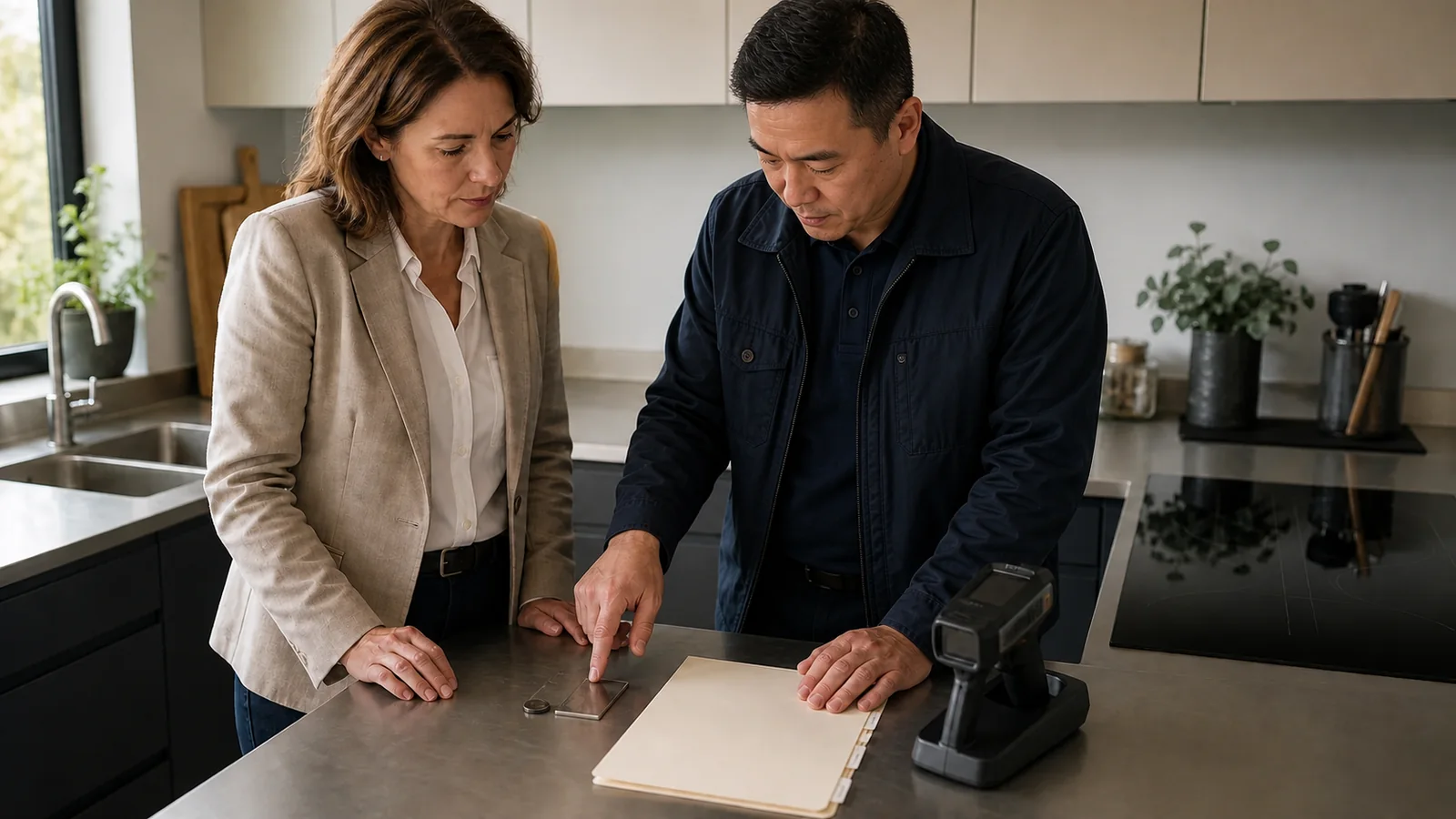
The magnet test is popular because it is cheap, immediate and easy to demonstrate. Its weakness is equally important: magnetism depends on alloy family, microstructure and processing, not just the grade name printed on a quotation. It can support preliminary sorting, but it cannot close a 304-versus-316 verification question.
Why the magnet result changes across one part
ASSDA explains that wrought austenitic grades such as 304 and 316 are generally regarded as non-magnetic in the annealed condition. Cold work can transform part of the microstructure and increase magnetic attraction. Formed corners, deep-drawn areas, drilled zones or heavily worked components can therefore respond differently from a flat section of the same material. See ASSDA’s magnetic-effects guide.
Other stainless families complicate the shortcut. Ferritic, martensitic and duplex grades can be strongly magnetic. A strong attraction does not mean “not stainless,” and weak or absent attraction does not uniquely identify 304 or 316.
What a magnet can and cannot tell you
| Observation | What it may indicate | What it does not prove |
|---|---|---|
| Strong attraction | A magnetic stainless family, carbon steel, or another ferromagnetic material may be present | That the material is fake or unsuitable |
| Weak attraction at a fold | Cold work may have changed an austenitic stainless area | That the flat sheet and fold are different grades |
| Little or no attraction | An annealed austenitic material may be present | That it is specifically 304, 316 or even a 300-series grade |
| Different response across parts | Processing, product form or material mix may differ | Which explanation is correct without traceability or testing |
Use a magnet only as a screening observation. Record where and how the response occurs, then check documents and traceability before accusing a supplier or accepting a grade claim.
Do not place the magnet on a wood-look, painted, coated or otherwise decorative front and treat that result as a cabinet-grade test. Use a component that the bill of materials identifies as stainless—such as an agreed worktop location, an accessible internal steel part or a labelled retained coupon. One coupon or one worktop edge still cannot prove that every component in the system uses the same grade.
Start with the purchase specification and documents
The order should name the required grade, product form, applicable product standard and requested inspection document. “304 stainless” alone leaves too much undefined. It should also identify which cabinet parts require that grade because fronts, bodies, fasteners, sinks, worktops and hardware may have different specifications.
The BSSA guide to EN 10204 certificates explains that type 3.1 includes results from specific inspection and is validated by an authorized manufacturer representative independent of manufacturing. Type 3.2 adds validation by an independent inspector or designated inspector. The certificate type is not the steel product standard and does not automatically prove the finished cabinet.
Do not assume that a cabinet quotation includes an EN 10204 3.1 certificate. Buyers and suppliers must agree the required document, availability, cost and traceability before quotation approval.
Keep traceability through fabrication
A genuine mill document is useful only if the supplied material remains connected to it. Cutting a coil or sheet into doors, cabinet bodies and small parts can break that chain unless the fabricator has a transfer method.
- Match the certificate’s producer, grade, dimensions, heat or cast number and test results to the incoming material record.
- Record coil, sheet or batch identifiers at goods receipt.
- Define how identifiers transfer to cut parts, work orders or cabinet IDs.
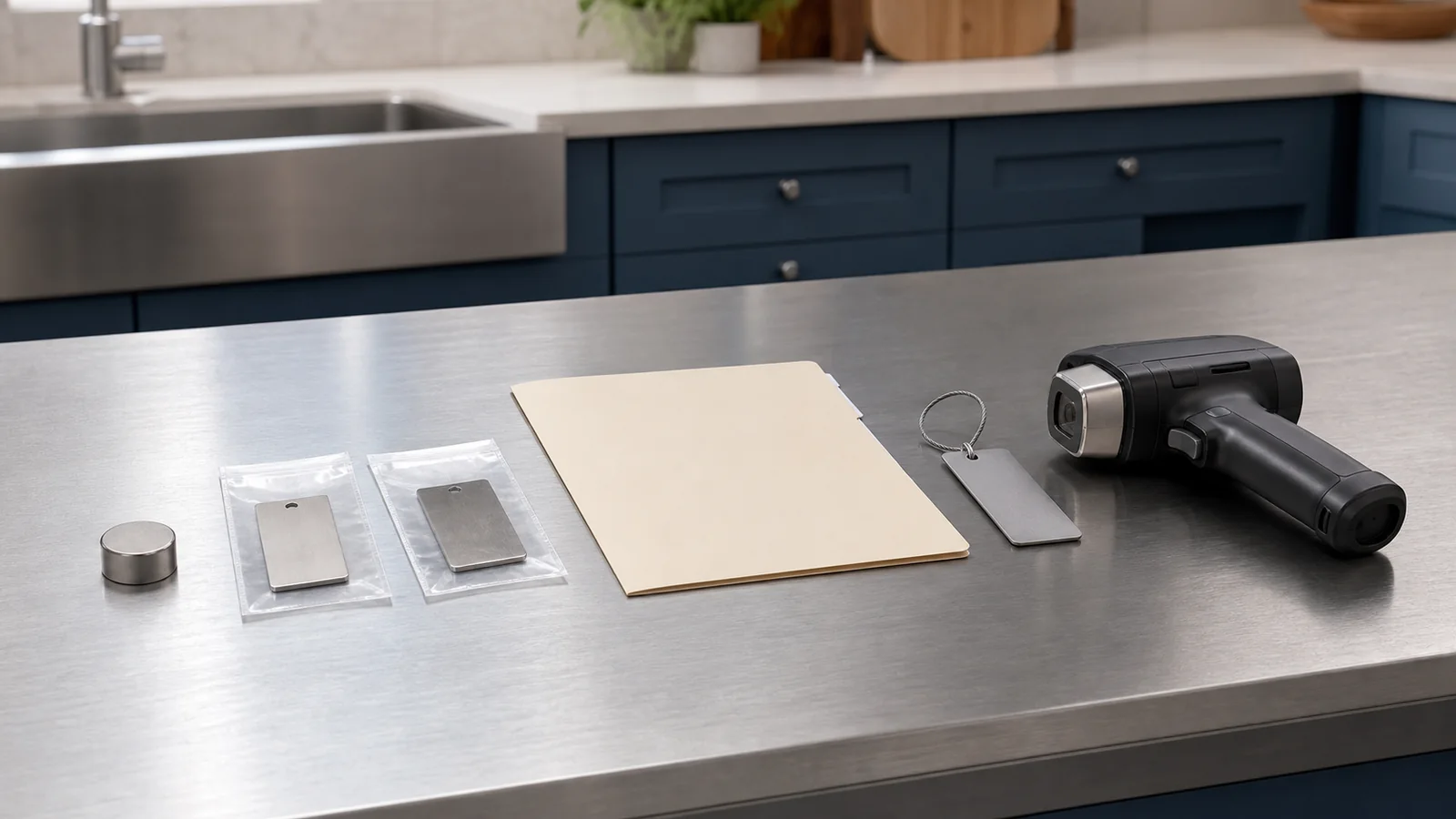
- Retain a labelled offcut or witness sample where the contract requires later verification.
- Keep photographs of material markings before protective film or cutting removes them.
- Link the pre-shipment inspection record to the same production batch.
BSSA has warned that altered certificates, missing heat-number links and misuse outside the document’s contractual scope undermine traceability. Review its material-certificate misuse notice.
Choose testing according to consequence
ASSDA’s grade-confirmation guide recommends matching the test method to job size, budget and the consequence of receiving the wrong alloy. That leads to a practical verification ladder:
- Document review: use when the supply chain is trusted and traceability is intact.
- Screening observations: use a magnet or appearance only to flag inconsistencies, never as final proof.
- Qualitative spot test: a molybdenum test can help distinguish a low-molybdenum material from a molybdenum-containing one, but several grades can produce a positive result.
- Portable instrumental analysis: use XRF or spark spectroscopy through a competent provider when project risk or a traceability gap justifies it.
- Laboratory analysis: use when a dispute, legal requirement or element not covered by portable testing demands a more complete result.
Testing a single convenient loose sample does not prove every cabinet part. The inspection plan must define the population, sampling locations, acceptance rule and response to a failed result.
Understand the limits of XRF
Portable X-ray fluorescence is widely used for alloy identification because it can report many alloying elements without leaving a test mark. The same ASSDA testing guide states that the surface should be clean and smooth and that sufficient measurement time is needed. It also notes that XRF cannot analyse light elements, especially carbon and nitrogen.
That limitation matters when someone wants to distinguish a low-carbon grade from its standard-carbon counterpart. An XRF reading that supports 316 chemistry does not by itself prove 316L. Coatings, surface condition, geometry and operator method also need to be considered by the testing provider.
Do not treat a molybdenum spot test as a complete grade certificate
ASSDA describes molybdenum spot testing as a comparative method that can distinguish 304/304L from 316/316L in a simple screening context. However, other molybdenum-containing grades can also test positive, and the chemical can mark the surface. A positive result supports the presence of molybdenum; it does not uniquely certify the complete grade or the entire shipment.
Build a risk-based verification plan
| Project condition | Reasonable verification direction |
|---|---|
| Indoor project, established supply chain, intact traceability | Clear purchase specification, agreed mill documents and incoming-record review may be sufficient |
| Coastal or outdoor exposure where grade choice materially affects risk | Stronger traceability, retained samples and agreed independent checks may be justified |
| Mixed stock, missing markings or inconsistent documents | Stop release and use qualified grade confirmation on an agreed sampling plan |
| Legal dispute or low-carbon grade must be proven | Use an appropriate laboratory or instrument method selected by a competent specialist |
The correct grade still depends on exposure, design, finish, fabrication and maintenance. Verification proves what material was supplied; it does not prove that the selected grade is suitable. Read 304 versus 316 for kitchen projects and the coastal outdoor-kitchen specification guide separately.
Red flags in material verification
- The supplier uses a magnet demonstration as the only evidence.
- The certificate has no link to material markings, batch records or finished cabinet IDs.
- The document describes a different thickness, product form or producer from the supplied stock.
- A copied PDF is offered without an original-source or authenticity check.
- One test on one loose coupon is claimed to prove an entire mixed shipment.
- XRF is claimed to prove carbon content or an L grade without an appropriate method.
- The quotation promises 316 everywhere but the BOM does not identify which parts are included.
Questions to put in the RFQ
- Which grade and product standard applies to each cabinet component?
- Which inspection document type is included, and who issues it?
- How will heat, coil or batch identity transfer from incoming sheet to finished parts?
- Will a labelled witness sample or offcut be retained?
- Does the project require supplier testing, independent PMI or laboratory analysis?
- What sampling plan and acceptance action apply if one result fails?
- Who pays for confirmatory testing when documentation is incomplete or disputed?
Bottom line
A magnet is a useful warning tool, not a grade certificate. Verify 304 or 316 through a defined purchase specification, authentic inspection documents, traceability into finished parts and testing proportionate to the consequence of error. Material proof is a chain; any isolated result can be misunderstood.
Review the project before production
Send your floor plan, destination country and project quantity for a preliminary specification review.