Blog / Systems
Systems · Buyer guide
Are Stainless-Steel Kitchen Cabinets Noisy? What Actually Controls the Sound
The short answer
Not inevitably. Residential stainless systems often use decorative fronts over a steel body. Sound can come from closing impact, hardware, alignment, a metal panel where present, loose parts or cookware. Test the actual assembled cabinet and diagnose the sound path; tapping a loose bare-steel panel does not represent the completed kitchen.

The word “noise” hides several different problems. In a residential stainless system, the visible fronts may be wood-look, painted or coloured while steel is concealed in the carcass or concentrated at the worktop. A front or drawer can strike the cabinet, a metal face or internal steel panel can ring where one is actually specified, hardware can rattle, and cookware can move inside a drawer. Those causes need different remedies. Treating them as one material defect leads to poor specifications and wasted fixes.
Separate four different sound paths
| Sound path | Typical clue | What to inspect |
|---|---|---|
| Closing impact | A short knock when the front reaches the cabinet | Closing speed, damper, bumpers, hinge or runner setup |
| Metal-panel resonance, where present | A metallic ring that continues briefly after impact | Which part is metal, its size, folds, reinforcement, layers, damping and mounting |
| Hardware or installation rattle | Buzzing, clicking or movement at one corner | Loose fasteners, misalignment, unsupported parts and cabinet levelling |
| Stored-item noise | Clinking that changes when the cabinet is emptied | Cookware contact, dividers, liners and drawer organization |
Research on aircraft and automotive panels establishes the general physical link between panel vibration and radiated sound. A NASA cabin-noise report, for example, explains that damping treatment reduces vibration at panel resonances and therefore reduces radiated sound. It is not a kitchen-cabinet test and provides no cabinet decibel claim; it supports the diagnostic principle only.
Soft-close hardware solves only the impact part
A correctly selected damper can reduce the speed and force of the final closing movement. Blum describes BLUMOTION as an integrated soft-close system for its hinges, lift systems and drawers. Its technical catalogue also explains that the mechanism responds to closing speed and front weight.
That evidence applies to the named Blum system, not to every component sold as “soft close.” More importantly, a damper cannot by itself stop a loose screw, a vibrating unsupported panel or two pans striking each other. Specify the exact hardware model and test it with the proposed front.
Panel construction and damping need sample evidence
Where a metal-facing front or broad internal steel panel is actually specified, geometry, edge returns, local reinforcement, bonded layers, backing material and mounting can all change its vibration. A decorative front has its own impact and hardware behaviour. Do not assume that one stainless sheet-thickness number predicts the sound of the assembled cabinet.
Ask the supplier to disclose which parts are steel, the construction of the actual visible front, and any damping or core material. If an adhesive, polymer layer or other core is used, verify its suitability for the expected temperature, moisture, cleaning products and replacement method. An acoustic benefit should not create an unreviewed material or serviceability risk.
Do not judge the kitchen by tapping a loose door
Tapping an unsupported bare-steel sample can reveal that two pieces sound different, but it does not reproduce the proposed kitchen and may not even represent the visible front. Hinges, runners, the concealed body, cabinet anchoring, worktops, adjacent panels and stored contents all change the result. A fair comparison uses a working representative cabinet.
Test the largest proposed residential front and drawer together with the actual inner body, not only a loose sample. Use the same hardware, handle or push-to-open method, internal accessories and installation support proposed for the order.
Compare a representative cabinet in a repeatable way
- Place the sample on a level, stable base and confirm all fixings are tight.
- Operate each door and drawer empty at normal user speed.
- Repeat with representative cookware or agreed test loads secured as they would be in use.
- Listen separately for impact, ringing, rattle and stored-item movement.
- Deactivate or adjust the damper only if the hardware instructions permit it, then record the difference.
- Touch suspected panels lightly after closure to see whether the continuing sound stops; this can help locate resonance but is not a certification test.
- Record the construction, hardware settings and sample identity so another supplier is tested under comparable conditions.
A smartphone recording can document a side-by-side comparison in the same room and position, but it should not be presented as a calibrated laboratory measurement.
Use construction and installation controls together
- Control the closing event: named soft-close hinges or runners, appropriate adjustment and bumpers where designed.
- Control the panel response: approved geometry, reinforcement, layers or damping demonstrated on the representative front.
- Control rattles: secure hardware, removable accessories, service panels and transport components.
- Control stored contents: dividers, liners and organizers suited to the homeowner’s cookware.
- Control installation: level cabinets, secure anchoring, adjusted reveals and no loose filler or plinth parts.
These are design options, not a guarantee that every cabinet will be silent. Their effectiveness must be confirmed in the proposed system.
Diagnose an installed complaint before changing parts
- Empty the affected cabinet and repeat the closing action.
- Check whether the sound occurs during travel, at final impact or after the door has stopped.
- Hold removable accessories or suspected panels one at a time to locate the rattle or resonance.
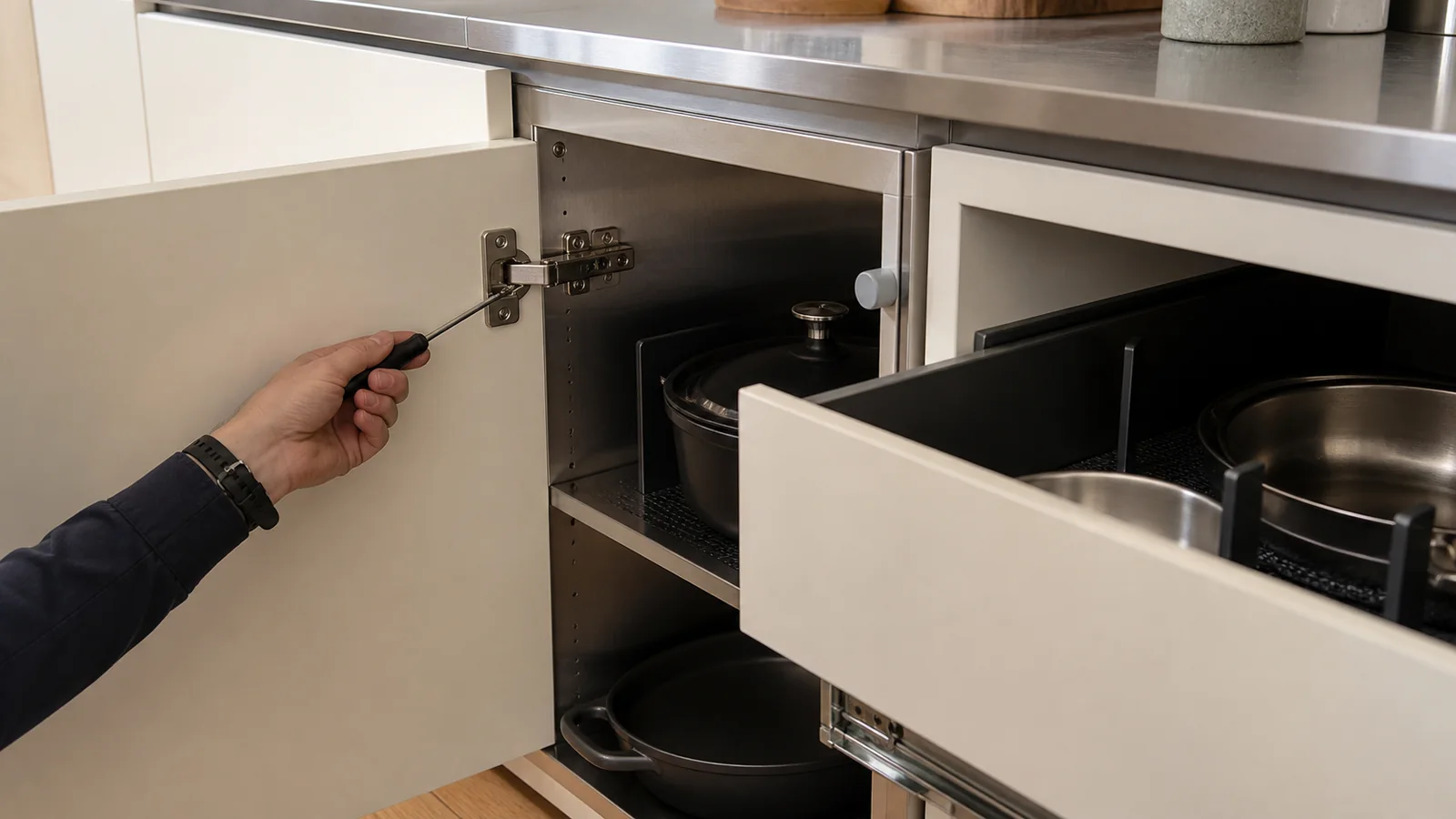
- Check cabinet level, hinge settings, runner fixing and loose fasteners according to the hardware instructions.
- Compare the affected unit with an identical nearby unit.
- Send the supplier a short video, cabinet ID, hardware model and description of when the sound occurs.
Do not add random foam, adhesive or drill holes before the supplier reviews the construction. An improvised change can interfere with drainage, cleaning, warranty, fire behaviour or later replacement.
Avoid universal noise claims
There is no evidence-based universal statement that residential stainless-steel cabinets are always louder or quieter than every alternative. There is also no single useful decibel threshold for all rooms, microphone positions and closing actions. A project should define an approved sample and comparison method instead of publishing a number that cannot be reproduced.
Questions to put in the RFQ
- What is the construction of the largest door, drawer front and end panel?
- Is any core, backing or damping layer used? Identify the material and service limitations.
- Which exact hinges and runners are included, and is soft close adjustable?
- Can the supplier provide a working sample with the proposed front weight?
- How are loose accessories secured for transport and installation?
- Who performs final levelling, alignment and hardware adjustment at site?
- How will an acoustic complaint be documented and diagnosed?
Panel construction also affects impact and visible deformation, so read the guide to scratches, dents and fingerprints. Use the quotation comparison checklist to make sure hardware and construction are compared on the same basis.
Bottom line
Stainless-steel kitchen cabinets can be quiet in residential use when closing impact, panel response, hardware, installation and storage are controlled together. The useful buyer question is not “Does metal make noise?” It is “Which part makes this sound, and has the proposed cabinet demonstrated an acceptable result?”
Review the project before production
Send your floor plan, destination country and project quantity for a preliminary specification review.